- FeaturesFeaturesHow it WorksUnderstand the MaxiFi features that help you build your lifetime planRoth Conversion OptimizerMaxiFi helps you optimize conversions and reduce taxesUse CasesHow can you put MaxiFi to use?Life Insurance Contingency PlanningGet peace of mind from life insurance recommendations tailored for youLiving Standard Monte CarloManage your living standard risk with confidence
- ServicesServicesOverviewChoose the right level of support for your plan and needsFlight CheckGet off the ground with comprehensive guidanceCo-PilotElevate your financial plan with one of MaxiFi’s certified financial plannersConcierge ServicePersonal, expert support to make the most of your financial plan
 Flight Check ServiceAsk your questions and make sure your plan is ready for take off with a MaxiFi expertLearn More
 - ResourcesResourcesWebinars and PodcastsExpert tips and guides to help you get the maximum from MaxiFiArticlesIn-depth commentary on the financial planning landscapeBooksFrom the world-renowned economist behind MaxiFiBlogInsights to help you optimize your financesFAQYour most pressing questions answeredFinancial GlossaryKey financial concepts explained in detail

- Why MaxiFiMaxiFiEconomics-Based PlanningHow MaxiFi's economics approach gives you a clear view of your financesCase StudiesReal stories about how MaxiFi helps users make smarter decisionsTestimonialsMaxiFi is trusted by households and experts for clarity and confidenceHow MaxiFi ComparesWith so many tools out there, how do you know MaxiFi is right for you?Press and ReviewsRead expert commentary and critical acclaim for MaxiFi
- Pricing
- AboutCompanyOur VisionThe best person to take control of your financial future is youMedia ResourcesLogos, background information, and media contactsFounder and AdvisorsMeet Laurence Kotlikoff and the visionary MaxiFi teamAffiliate ProgramShare MaxiFi with your audience to help them take control of their financesCareersWhy working at MaxiFi is rewarding, empowering, and impactfulContactQuestions or feedback? Get in touch with the MaxiFi team

DIY MaxiFi vs Working With a Financial Planner: Cost-Benefit Analysis
For many people approaching retirement, the hardest planning question is no longer how much they have saved. It is how to decide whether to plan independently or work with a professional. Advances in financial planning software have made self-directed planning far more capable than it was a decade ago, while the role and cost of financial advisors continue to evolve. As a result, more households are weighing DIY financial planning against working with a financial planner, or some combination of both.
This question is especially relevant for users of MaxiFi. MaxiFi is designed as a comprehensive, economics-based planning system that allows individuals to model lifetime outcomes across income, taxes, Social Security, spending, and longevity. For many users, this raises a natural follow-up question. Is software like MaxiFi enough on its own, or does working with a financial planner still add value?
The answer is rarely absolute. Planning outcomes depend less on whether someone uses software or an advisor and more on complexity, coordination needs, and confidence in interpreting tradeoffs. In recent planning contexts, this distinction has become clearer as longer retirements, overlapping income sources, and tax interactions place greater demands on planning accuracy and consistency.
This guide examines the cost-benefit tradeoffs between using MaxiFi as a DIY financial planning tool and working with a financial planner. Rather than offering a recommendation, it explains what each approach does well, where each has limitations, and how they can sometimes complement one another. The goal is to help readers understand when self-directed planning may be sufficient, when professional involvement may add value, and why the choice is often situational rather than permanent.

Key Takeaways
- DIY financial planning with MaxiFi refers to economics-based planning that calculates a household's affordable spending level, not conventional planning software that relies on rules of thumb for its assumptions.
- MaxiFi functions as a planning engine that models coordination across income, taxes, Social Security, spending, and longevity.
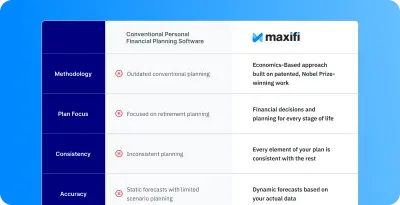
- Most financial planners use conventional planning software and direct their clients' investments, earning ongoing fees tied to assets under management. They also provide services beyond calculation, such as behavioral support, judgment under uncertainty, and communication across households.
- Software excels at consistency, transparency, and scenario comparison, while advisors excel at interpretation and human context.
- The cost difference between software and advisory services is driven by fee structure, duration, and scope rather than quality alone.
- Higher advisory fees do not automatically translate into better planning outcomes, especially for well-defined scenarios.
- DIY planning can be effective when assumptions are stable and users are comfortable interpreting tradeoffs.
- Advisor involvement may add value during periods of emotional stress, family complexity, or decision paralysis.
- MaxiFi can be used independently or alongside a financial planner, depending on planning needs.
- The choice between planner or software is not a reflection of sophistication, but of timing and complexity.
- Planning needs often change over time, making hybrid approaches common among experienced households.
- There is no single correct approach to retirement planning, only tradeoffs shaped by individual circumstances.
What DIY Financial Planning With MaxiFi Actually Means
DIY financial planning is often misunderstood. In casual use, the term can suggest spreadsheets, rough estimates, or relying on simplified rules to guide long-term decisions. In a MaxiFi context, DIY planning means something very different. It refers to using structured, economics-based software to model a complete lifetime financial system across income, taxes, Social Security, spending, and longevity, with the user retaining control over assumptions and decisions.
Planning this way is not about guessing outcomes or optimizing a single variable. It is about building a coherent model that reflects how financial elements interact over decades. DIY planning with MaxiFi assumes that users are willing to engage with complexity, examine tradeoffs, and interpret results within a coordinated framework rather than relying on shortcuts or external prescriptions.
Self-Directed Planning vs Rules of Thumb
DIY planning is often conflated with rules of thumb such as fixed withdrawal rates, target savings multiples, or simple age-based decisions. These heuristics are easy to communicate, but they compress complex systems into single numbers. While they may help explain basic mechanics, they tend to fail when applied to real households with uneven income, taxes, benefits, and changing spending patterns.
MaxiFi’s approach differs fundamentally from rules-based planning. Instead of starting with a conclusion and working backward, it models the full set of constraints and interactions that shape lifetime outcomes. Social Security claiming affects taxes. Taxes affect spending capacity. Spending choices affect sustainability under uncertainty. DIY planning with MaxiFi means engaging with these relationships directly rather than substituting them with generalized formulas.
The result is not a single answer, but a clearer understanding of how different assumptions interact and what tradeoffs emerge under different scenarios.
What MaxiFi Handles Well
Software excels at tasks that require consistency and system-level coordination. MaxiFi applies the same logic across decades without fatigue or bias, ensuring that assumptions entered in one area are reflected everywhere they apply. This consistency is difficult to replicate manually or through informal planning.
MaxiFi also handles scenario comparison well. Users can explore how changes in income timing, tax assumptions, benefit coordination, or longevity affect outcomes without rebuilding the entire plan each time. This allows for structured exploration rather than one-off estimates.
Transparency is another strength. Because the planning logic resides in the software, users can see how outcomes are generated and trace results back to assumptions. This makes DIY planning less about trust in an intermediary and more about understanding how the system behaves.
What Financial Planners Actually Do That Software Does Not
Understanding what software does well helps clarify where human planners add value. Financial planners are not simply calculators with opinions. Their role often centers on services that are difficult or impossible to automate, particularly those involving judgment, behavior, and communication.
This distinction matters when comparing DIY planning with working alongside a professional.
Judgment, Behavior, and Communication
Human planners play an important role in helping people navigate uncertainty and emotion. Retirement decisions often involve anxiety, family dynamics, and fear of irreversible mistakes. Software can model outcomes, but it cannot reassure, challenge, or reframe concerns in the way a person can.
Planners also help translate technical results into language that resonates with clients and their families. They can facilitate conversations, mediate disagreements, and help households align around shared expectations. These functions are not about optimization. They are about interpretation and human context.
For some users, this support is central to their planning process, regardless of how sophisticated the underlying model may be.
Limits of Delegated Planning
Delegating planning to a professional introduces tradeoffs as well. When planning logic is outsourced, transparency can decrease. Clients may receive conclusions without fully understanding how assumptions were chosen or how tradeoffs were evaluated.
Cost is another consideration. Advisory fees, particularly those tied to assets under management, compound over long retirements and can materially affect lifetime outcomes. Delegated planning can also reduce a client’s familiarity with their own financial system, making it harder to adapt when circumstances change.
These limitations do not make advisory relationships inappropriate. They highlight that working with a planner shifts where control and interpretation reside.
Cost Differences Between DIY Planning and Advisory Services
Comparing the cost of software and advisory services requires more than listing prices. It requires understanding how costs accumulate and what they are tied to.
DIY planning costs are typically subscription-based or tied to specific services. Advisory costs often take the form of ongoing fees, flat retainers, or asset-based charges that persist regardless of planning activity.
Ongoing Fees vs One-Time or Subscription Costs
Advisory fees are often recurring and open-ended. Over long retirements, even modest annual percentages can compound into substantial lifetime costs. These fees may cover a wide range of services, some of which a client uses regularly and others infrequently.
Software costs tend to be more predictable. Subscription or service-based pricing allows users to engage when planning needs are active and step back when they are not. This structure aligns costs more closely with usage rather than asset size or time.
Cost structure matters because retirement planning spans decades, and small differences in recurring expenses can have long-term effects.
Cost Is Not the Same as Value
Higher cost does not guarantee better outcomes. Value depends on whether a service addresses the specific complexity a household faces. In relatively stable scenarios, sophisticated software may provide most of the needed insight at a lower cost. In emotionally complex or highly customized situations, professional involvement may add value that software alone cannot.
Understanding this distinction helps reframe the decision as situational rather than hierarchical.
When MaxiFi Alone May Be Sufficient
There are many planning situations where self-directed planning with MaxiFi can be effective. These situations are defined by structure and confidence, not by net worth or education level.
Households that are comfortable interpreting tradeoffs and exploring scenarios often find that software-based planning meets their needs. Plans with relatively stable assumptions, such as predictable income streams and spending patterns, are well suited to structured modeling. Users who value transparency and direct control over assumptions may prefer keeping the planning engine within the software.
In these contexts, MaxiFi functions as a comprehensive planning system rather than a supplement, allowing users to engage deeply with their plan without delegating interpretation.
When Working With a Planner May Add Value
There are also circumstances where advisor involvement can be helpful without being universally necessary. High emotional stress, such as planning after a loss or during major life changes, can make independent interpretation more difficult. Complex family dynamics may require facilitation rather than additional modeling.
In some cases, users understand the numbers but struggle with confidence or decision paralysis. Here, the value of a planner lies less in calculations and more in helping people move forward with clarity.
These situations reflect human complexity rather than financial complexity.
Using MaxiFi With a Financial Planner
DIY planning and professional advice are not mutually exclusive. Many households use MaxiFi alongside a financial planner, with the software serving as the planning engine and the advisor acting as an interpreter or collaborator.
In this structure, MaxiFi provides a transparent, economics-based framework for evaluating tradeoffs, while the planner helps contextualize results and support decision-making. This approach keeps planning logic visible while still allowing for human judgment and discussion.
Used this way, MaxiFi does not replace professional advice. It changes how that advice is grounded and evaluated.
Choosing Between Software, a Planner, or Both
Choosing between DIY planning, working with a planner, or combining both approaches is not a one-time decision. Planning needs evolve over time. A household may rely primarily on software during stable periods and seek professional input during transitions.
The most effective approach is often contextual rather than fixed. What matters is not choosing the right tool forever, but using the right level of support for the planning questions at hand.
Financial Planning that Puts You in Control
Frequently Asked Questions About DIY MaxiFi and Financial Planners
Important Considerations
The discussion of DIY financial planning with MaxiFi and working with a financial planner reflects current understanding of retirement planning practices and tools. Any examples or scenarios referenced are illustrative and are intended to explain how different planning approaches function, not to suggest specific actions or outcomes. The comparison focuses on structure and tradeoffs rather than recommending one approach over another.
Retirement planning outcomes vary widely across households and depend on factors such as health and longevity, the timing and mix of income sources, tax exposure and policy changes, and evolving spending patterns. Long term planning involves uncertainty and competing tradeoffs rather than single right answers. Both software-based planning and professional advice have limitations, and simplified assumptions or one dimensional comparisons may overlook important interactions that affect lifetime outcomes.
Disclaimer
This article provides general educational information only and does not constitute legal, tax, or estate planning advice. Beneficiary designations, estate laws, and tax regulations vary significantly by state, account type, and individual circumstances. The information presented here is not intended to be a substitute for personalized legal or financial advice from qualified professionals such as estate planning attorneys, tax advisors, or financial planners. Beneficiary rules are subject to change and can have significant legal and tax implications. Before designating, changing, or making decisions about beneficiaries, you should consult with appropriate professionals who can evaluate your specific situation and applicable state and federal laws.