- FeaturesFeaturesHow it WorksUnderstand the MaxiFi features that help you build your lifetime planRoth Conversion OptimizerMaxiFi helps you optimize conversions and reduce taxesUse CasesHow can you put MaxiFi to use?Life Insurance Contingency PlanningGet peace of mind from life insurance recommendations tailored for youLiving Standard Monte CarloManage your living standard risk with confidence

- ServicesServicesOverviewChoose the right level of support for your plan and needsFlight CheckGet off the ground with comprehensive guidanceCo-PilotElevate your financial plan with one of MaxiFi’s certified financial plannersConcierge ServicePersonal, expert support to make the most of your financial plan
 Flight Check ServiceAsk your questions and make sure your plan is ready for take off with a MaxiFi expertLearn More
 - ResourcesResourcesWebinars and PodcastsExpert tips and guides to help you get the maximum from MaxiFiArticlesIn-depth commentary on the financial planning landscapeBooksFrom the world-renowned economist behind MaxiFiBlogInsights to help you optimize your financesFAQYour most pressing questions answeredFinancial GlossaryKey financial concepts explained in detail

- Why MaxiFiMaxiFiEconomics-Based PlanningHow MaxiFi's economics approach gives you a clear view of your financesCase StudiesReal stories about how MaxiFi helps users make smarter decisionsTestimonialsMaxiFi is trusted by households and experts for clarity and confidenceHow MaxiFi ComparesWith so many tools out there, how do you know MaxiFi is right for you?Press and ReviewsRead expert commentary and critical acclaim for MaxiFi
- Pricing
- AboutCompanyOur VisionThe best person to take control of your financial future is youMedia ResourcesLogos, background information, and media contactsFounder and AdvisorsMeet Laurence Kotlikoff and the visionary MaxiFi teamAffiliate ProgramShare MaxiFi with your audience to help them take control of their financesCareersWhy working at MaxiFi is rewarding, empowering, and impactfulContactQuestions or feedback? Get in touch with the MaxiFi team

FI Number vs Living Standard: Which Retirement Target Metric Matters More?
An FI number is an asset target that estimates when a portfolio could cover ongoing spending without earned income. It is calculated by dividing estimated annual expenses by an assumed withdrawal rate, at 4%, the rule of 25. That is a rule of thumb, not a plan, as the result is a single net worth figure resting on assumptions no household actually lives by.
Searches for an FI number calculator often reflect a desire for clarity. Many people want a single figure that signals when work becomes optional and retirement feels sustainable. The FI number offers that promise by translating spending assumptions into a clear asset target. Once the number is reached, retirement readiness can appear settled.
This framing matters because FI numbers have become one of the most widely used retirement target metrics, especially in FIRE focused planning. They shape saving behavior, investment risk tolerance, and perceptions of progress. A higher net worth is often equated with greater security, while falling short can feel like failure even when day to day living standards remain stable.
At the same time, retirement is not experienced as a balance sheet. What matters is whether income, savings, and benefits can support a desired living standard over time. Taxes, spending patterns, health costs, and longevity all influence how resources translate into real consumption. Two households with identical FI numbers can experience very different retirements depending on how these factors interact.
This guide examines the difference between FI numbers and living standard based planning. It explains what each metric is designed to measure, why FI numbers became dominant, and where they tend to break down. The goal is not to replace one metric with another, but to clarify which questions each answers and why living standard often provides a more reliable lens for evaluating long term retirement sustainability.

Key Takeaways
- An FI number represents a target asset level derived from spending assumptions and withdrawal rules.
- FI number calculation focuses on net worth thresholds rather than lived retirement outcomes.
- Living standard planning evaluates whether spending can be sustained over time, not whether a balance target has been reached.
- FI numbers became popular because they are simple, comparable, and easy to calculate using standard tools.
- Retirement success depends on spending capacity, taxes, income timing, and longevity, not asset totals alone.
- Identical FI numbers can support very different living standards due to differences in tax treatment and spending patterns.
- Living standard metrics emphasize consumption smoothing rather than accumulation milestones.
- Net worth based targets often overlook variability in retirement expenses and income sources.
- FI number accuracy declines as household complexity increases.
- Lifestyle based planning highlights tradeoffs and uncertainty rather than fixed outcomes.
- Retirement target metrics answer different questions and should not be treated as interchangeable.
- Evaluating living standards alongside asset targets provides a clearer picture of long term financial independence.
What an FI Number Is Trying to Measure
An FI number is designed to translate future spending into a single asset target. It typically answers a narrow question. How large does a portfolio need to be so that withdrawals can cover ongoing expenses without earned income. Most FI number calculations rely on estimated annual spending combined with an assumed withdrawal rate to produce a target balance.
This framing treats retirement readiness as an accumulation problem. Progress is measured by how close current net worth is to a predefined number. The appeal is clarity. A single figure creates a visible finish line and allows people to track progress over time. FI number calculators reinforce this framing by reducing a complex, long term question into a simple output that feels objective and precise.
What the FI number does not attempt to measure is how retirement unfolds in practice. It does not evaluate how income sources interact, how taxes change over time, or how spending evolves across different stages of retirement. It captures a relationship between assets and assumed withdrawals, not the lived experience of sustaining a lifestyle.
Why FI Numbers Became the Default Retirement Metric
FI numbers became widespread because they are easy to calculate, easy to compare, and easy to communicate. They fit naturally with accumulation focused thinking, where progress is tracked through balances and net worth milestones. Online calculators, spreadsheets, and rules of thumb made it simple to estimate an FI number and revisit it regularly.
Within FIRE oriented planning, FI numbers also offered a shared language. People could compare targets, timelines, and progress using a common metric. This standardization helped build communities and conversations around early retirement goals. The FI number worked well as an orientation tool because it simplified a complex system into something tangible.
The same features that made FI numbers popular also limited their usefulness. By focusing on a single balance threshold, the metric encouraged people to treat retirement readiness as binary. Either the number is reached or it is not. This framing can obscure the gradual, conditional nature of financial independence and the role of uncertainty in long term planning.
The Core Limitation of FI Numbers
The primary limitation of FI numbers is not faulty arithmetic. It is scope. FI numbers evaluate assets in isolation, while retirement outcomes depend on how resources are converted into spending over time. Net worth alone does not determine whether a household can maintain its desired living standard.
Taxes are a clear example. Two households with the same FI number may face very different tax burdens depending on account structure and withdrawal timing. Spending patterns introduce further variation. Health costs, housing changes, and family support obligations rarely remain constant across retirement. Longevity adds another layer of uncertainty that cannot be reduced to an average.
Because FI numbers collapse these variables into a single figure, they can create a false sense of precision. The number appears exact, but the underlying assumptions remain broad. As household complexity increases, FI number accuracy tends to decline, even when the calculation itself remains consistent.
What Living Standard Measures Instead
Where an FI number measures a balance, a living standard measures spending capacity. Living standard based retirement planning does not ask whether a portfolio has reached a certain size. It asks whether earnings, savings, Social Security, and pensions can support a chosen level of consumption for as long as the household lives. The FI number vs living standard distinction comes down to this: one metric counts what you have, the other calculates what you can afford to spend.
A living standard reflects what retirement actually feels like. It incorporates how much can be spent, when it can be spent, and how reliably that spending can be sustained. Taxes, income timing, and benefit coordination directly affect this outcome, and so do changes in spending needs across different life stages. A household with $1.5 million in taxable accounts and a household with $1.5 million in a traditional IRA have the same FI number and materially different living standards.
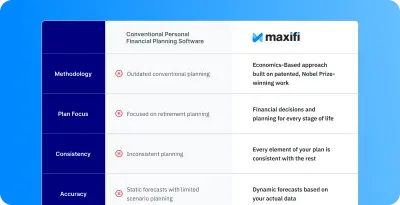
This reframes retirement readiness as an ongoing condition rather than a threshold. Financial independence is evaluated by whether consumption can be smoothed across time, not by whether a single number has been achieved, which is also why the approach remains uncommon in practice. Most consumer software asks you to state a target retirement spending level and tests whether your assets survive it. MaxiFi is the only consumer financial planning software built the other way round, solving for the discretionary spending your resources can actually sustain and smoothing that living standard across every remaining year of life.
Consumption Smoothing and Retirement Outcomes
Consumption smoothing is an economic concept that describes how households seek to maintain relatively stable living standards across different phases of life. Rather than maximizing assets at one point in time, the goal is to avoid sharp changes in consumption that reduce well being.
In retirement planning, consumption smoothing highlights why volatility matters more than averages. A plan that supports a high level of spending early but requires sharp reductions later may look successful by FI number standards, yet fail to preserve living standard. Conversely, a plan with a lower asset balance may sustain stable consumption if income sources and spending are well coordinated.
FI numbers struggle to capture this dynamic because they focus on accumulation endpoints. Living standard metrics align more closely with how people experience financial security, emphasizing continuity and resilience rather than peak balances.
FI Number vs Living Standard in Practice
In practice, FI numbers and living standard metrics frame retirement readiness in fundamentally different ways.
How FI numbers frame retirement readiness
FI numbers frame readiness as reaching a static threshold. Once the target balance is achieved, retirement is assumed to be feasible. This approach emphasizes net worth, assumes stable relationships between assets and spending, and treats retirement as a state that begins once a condition is met.
The limitation of this framing is that it does not adjust easily to changing circumstances. Variations in taxes, spending needs, or income timing are not reflected in the number itself. As a result, FI numbers can overstate readiness when conditions shift or when assumptions fail to hold.
How living standard metrics frame retirement readiness
Living standard metrics frame readiness as the ability to sustain consumption over time. Rather than asking whether a target has been reached, the focus is on whether resources can support spending across different scenarios. This approach naturally incorporates uncertainty, tradeoffs, and coordination across income sources.
Because it evaluates flows instead of balances, living standard planning highlights risks that FI numbers overlook. It shows how small changes in taxes, healthcare costs, or longevity can affect outcomes even when asset levels remain unchanged.
Why Planning by Living Standard Reveals Tradeoffs
Focusing on living standards brings tradeoffs into view. Decisions about when to claim income sources, how to structure withdrawals, or how much spending flexibility to maintain all influence outcomes. These tradeoffs exist regardless of whether someone tracks an FI number, but they become visible only when planning moves beyond static targets.
Living standard based evaluation also clarifies that there is no single right answer. Different households may accept different levels of variability, risk, or adjustment over time. What matters is how well the plan supports desired consumption under uncertainty, not whether it aligns with a predefined rule.
Metrics Are Tools, Not Answers
FI numbers and living standard metrics serve different purposes. FI numbers can help frame accumulation progress and provide orientation during saving years. Living standard metrics offer deeper insight into sustainability and resilience during retirement.
Neither metric determines success on its own. In more complex situations, comprehensive financial planning software such as MaxiFi can be used to model how income, taxes, savings, and spending interact across time. This system level view places FI numbers within a broader context, emphasizing understanding over thresholds and coordination over single target outcomes.
Financial Planning that Puts You in Control
Frequently Asked Questions About FI Numbers and Living Standards
Important Considerations
The discussion of FI numbers and living standards reflects current understanding of retirement planning concepts and commonly used assumptions, where relevant. The examples and comparisons presented are illustrative and intended to explain how different retirement target metrics function, not to suggest specific actions or decisions. In practice, retirement outcomes vary widely depending on individual circumstances, including health and longevity, income sources and their timing, tax treatment, and evolving spending patterns over time.
Long term retirement planning involves tradeoffs and uncertainty rather than a single correct metric or outcome. Simplified targets such as FI numbers can help frame accumulation progress, but they may overlook important interactions that affect spending capacity and sustainability. In more complex situations, comprehensive financial planning software such as MaxiFi can help model how income, taxes, savings, and spending interact across time, providing context for evaluating living standards without reducing planning decisions to a single number.
Disclaimer
This article provides general educational information only and does not constitute legal, tax, or estate planning advice. Beneficiary designations, estate laws, and tax regulations vary significantly by state, account type, and individual circumstances. The information presented here is not intended to be a substitute for personalized legal or financial advice from qualified professionals such as estate planning attorneys, tax advisors, or financial planners. Beneficiary rules are subject to change and can have significant legal and tax implications. Before designating, changing, or making decisions about beneficiaries, you should consult with appropriate professionals who can evaluate your specific situation and applicable state and federal laws.