- FeaturesFeaturesHow it WorksUnderstand the MaxiFi features that help you build your lifetime planRoth Conversion OptimizerMaxiFi helps you optimize conversions and reduce taxesUse CasesHow can you put MaxiFi to use?Life Insurance Contingency PlanningGet peace of mind from life insurance recommendations tailored for youLiving Standard Monte CarloManage your living standard risk with confidence

- ServicesServicesOverviewChoose the right level of support for your plan and needsFlight CheckGet off the ground with comprehensive guidanceCo-PilotElevate your financial plan with one of MaxiFi’s certified financial plannersConcierge ServicePersonal, expert support to make the most of your financial plan
 Flight Check ServiceAsk your questions and make sure your plan is ready for take off with a MaxiFi expertLearn More
 - ResourcesResourcesWebinars and PodcastsExpert tips and guides to help you get the maximum from MaxiFiArticlesIn-depth commentary on the financial planning landscapeBooksFrom the world-renowned economist behind MaxiFiBlogInsights to help you optimize your financesFAQYour most pressing questions answeredFinancial GlossaryKey financial concepts explained in detail

- Why MaxiFiMaxiFiEconomics-Based PlanningHow MaxiFi's economics approach gives you a clear view of your financesCase StudiesReal stories about how MaxiFi helps users make smarter decisionsTestimonialsMaxiFi is trusted by households and experts for clarity and confidenceHow MaxiFi ComparesWith so many tools out there, how do you know MaxiFi is right for you?Press and ReviewsRead expert commentary and critical acclaim for MaxiFi
- Pricing
- AboutCompanyOur VisionThe best person to take control of your financial future is youMedia ResourcesLogos, background information, and media contactsFounder and AdvisorsMeet Laurence Kotlikoff and the visionary MaxiFi teamAffiliate ProgramShare MaxiFi with your audience to help them take control of their financesCareersWhy working at MaxiFi is rewarding, empowering, and impactfulContactQuestions or feedback? Get in touch with the MaxiFi team

FIRE Number: Why Standard Calculators Get Your Target Wrong
FIRE stands for Financial Independence, Retire Early. It describes an approach in which a household saves and invests a large share of its income to build a portfolio big enough to cover living costs without relying on employment. The FIRE number is the portfolio balance assumed to make that possible, and a FIRE number calculator is the tool most people use to estimate it.
The arithmetic is straightforward. Estimate annual spending in retirement, then divide that figure by an assumed annual withdrawal rate. The rate most commonly used is 4 percent, drawn from research into how much a portfolio could historically have supported over a fixed retirement period without being exhausted. Dividing by 4 percent produces the same result as multiplying by twenty five, which is why the 4 percent rule and the 25x rule describe the same calculation from different directions. A household spending 60,000 dollars a year arrives at a FIRE number of 1.5 million dollars.
It is worth being clear at the outset about what that calculation is. It is a rule of thumb, not a plan. The 4 percent rule was derived from a fixed thirty year horizon, a particular mix of stocks and bonds, and historical US market returns, and it says nothing about taxes, Social Security, pensions, Roth conversions, or how spending changes across a retirement that may run considerably longer. Every FIRE number calculator built on it inherits those assumptions, whether or not it discloses them.
The appeal is obvious, given its simplicity. Multiply annual spending by a rule, plug it into a FIRE calculator, and the path to early retirement appears mapped out. A single financial independence number turns an uncertain future into a concrete figure, which is why people searching for a free calculator usually want exactly that - an approximate target that tells them when work becomes optional.
This matters because the FIRE number has become a decision anchor for many households. It influences savings behavior, investment risk, career choices, and even where people choose to live. The risk is a target that is wrong by a wide margin is not a harmless approximation when it is driving those decisions. Spending does not stay flat, taxes do not remain constant, income sources interact, and longevity is uncertain. A basic calculator built to output one number cannot reflect how these factors combine over time.
This guide explains why standard FIRE number calculators often miss the mark. It walks through how FIRE numbers are typically calculated, why rules like the 4 percent and 25x rules became widespread, and where these tools break down in practice. Rather than offering prescriptions, the focus is on assumptions, interactions, and limitations, and on why a FIRE number is a starting estimate rather than a definitive answer about long term financial independence.

Key Takeaways
- A FIRE number calculator is designed to estimate a target asset level, not to model full retirement outcomes.
- Most FIRE calculators rely on simplified assumptions about spending, returns, and withdrawals.
- The 4 percent assumption behind the 25x rule has been revised in both directions, moving the target by hundreds of thousands of dollars.
- Taxes materially affect usable spending, yet many FIRE calculators apply flat or generic tax assumptions.
- Two people with the same financial independence number can experience very different outcomes due to account structure and income timing.
- Social Security and other income sources are often excluded or treated as static inputs, even though timing and coordination matter.
- Spending patterns typically change over retirement, which makes fixed spending assumptions unreliable.
- Longevity uncertainty means retirement duration cannot be reduced to an average or assumed end date.
- Location influences taxes, healthcare costs, and policy exposure, but is rarely modeled in FIRE target calculations.
- FIRE numbers describe accumulation targets, not sustainability of spending across decades.
- Simplified calculators are useful for orientation, but they cannot capture system level interactions.
- Financial independence is shaped by coordination across income, taxes, and spending rather than by reaching a single number.
What a FIRE Number Calculator Is Designed to Do
Most FIRE calculators never ask how long your retirement will be. The assumption is buried inside the withdrawal rate instead. The 4 percent figure was derived from a fixed thirty year horizon, which is roughly right for someone retiring at 65 and potentially very wrong for someone retiring at 40 with many years ahead of them.
Bengen's updated research makes the difference explicit. He now puts the safe starting rate at 4.7 percent over thirty years but 4.2 percent over fifty. Morningstar's modelling shows the same relationship from the other direction, with older retirees able to spend meaningfully more than its 3.9 percent base case precisely because their horizon is shorter. Others working specifically on early retirement horizons argue for 3.25 to 3.5 percent once the plan runs forty years or longer.
That range matters more than it appears. A household spending $60,000 a year needs about $1.28 million at 4.7 percent and about $1.85 million at 3.25 percent. Same lifestyle, same basic calculator, with the only difference being how long the retirement is assumed to last. A tool that does not ask your age cannot make that adjustment for you.
How FIRE calculators frame the retirement question
FIRE calculators frame retirement primarily as an accumulation problem rather than a coordination problem. The central variable is portfolio size. Other factors are simplified, averaged, or excluded altogether. Spending is usually treated as fixed. Returns are assumed to be stable over time. Taxes may be applied as a flat rate or ignored. Income sources beyond the investment portfolio are often left out.
This framing narrows the question being asked. Instead of examining how income, taxes, benefits, and spending interact across time, the calculator focuses on whether a single balance threshold has been reached.
Focus on spending multiples and withdrawal assumptions
At the core of most FIRE calculators is a spending multiple. Whether labeled as a FIRE number calculator, FIRE goal calculator, or financial independence number tool, the logic remains consistent. Estimate annual spending and apply a rule driven withdrawal rate. This produces a target for your savings and investment portfolio that is intended to last over time, and reaching it is treated as the point at which work becomes optional.
Because the structure is standardized, different tools often produce similar results when given similar inputs. Differences usually stem from the assumed withdrawal rate rather than from deeper modeling of household complexity. Agreement between calculators is not confirmation that the target is right. It only means they share the same assumptions.
Why they stop at a single target number
Stopping at one number reflects what these tools are designed to do. They are estimation tools, not system models. Their purpose is to illustrate how savings relate to spending under simplified assumptions. They are not built to evaluate how income timing, taxes, benefits, or spending changes interact over decades.
The simplicity that makes FIRE calculators popular also defines their limits. They offer clarity by isolating variables, which becomes increasingly restrictive as real world complexity grows.
The 25x Rule and Why It Became Popular
The 25x rule is one of the most widely referenced shortcuts in the FIRE movement. It suggests estimating a FIRE number by multiplying annual spending by twenty five. The rule is rooted in research on withdrawal sustainability under historical market conditions and was intended as a broad heuristic rather than a personalized planning tool.
Its appeal lies in clarity. The rule compresses retirement planning into a single calculation that is easy to understand, communicate, and track. As FIRE communities expanded, the 25x rule became a shared reference point for discussing progress toward financial independence.
What the 25x rule assumes
The 25x rule rests on several simplifying assumptions that are rarely stated explicitly. These assumptions help explain both its usefulness and its limitations.
Fixed spending
The rule assumes spending remains relatively stable in real terms over retirement. It does not account for changes driven by health care needs, housing transitions, family support, or lifestyle shifts that often occur over time.
No coordination with benefits
Social Security and other income sources are typically excluded from the calculation or treated as add-ons rather than integrated components. The timing of these benefits and their interaction with withdrawals are not reflected in the target itself.
Stable returns
Market behavior is reduced to an average. Variability, sequencing, and timing effects are not part of the rule’s logic. This simplifies communication but limits insight into how outcomes unfold across different scenarios.
The 25x rule was never designed to show how the pieces of a household's finances fit together. It cannot tell you when to claim Social Security, which accounts to draw from first, the optimal Roth conversion strategy, how a spouse's income or benefits change the picture, or what any of it does to your tax bill. It explains one relationship, between spending and portfolio size, and leaves the rest to you.
Where FIRE Number Calculators Start to Break Down
FIRE calculators do not fail because they use incorrect math. They break down because they isolate variables that interact in practice. When coordination is ignored, identical FIRE numbers can lead to very different outcomes.
Taxes and account structure
Account type has a direct impact on usable spending. Withdrawals from pre tax accounts increase taxable income. Roth withdrawals do not. Taxable accounts introduce capital gains considerations. A FIRE target amount calculated before tax does not translate evenly into after tax spending.
Two households with the same financial independence number can face different effective tax burdens depending on how assets are held and when withdrawals occur. Flat tax assumptions hide these differences and can distort perceived readiness.
Social Security and other income sources
Ignoring Social Security timing can materially distort early retirement targets. Even for those retiring well before eligibility, Social Security often becomes a significant income source later in retirement. When benefits begin and how they interact with portfolio withdrawals affect both taxes and sustainability.
When income sources are evaluated independently, the model cannot show how decisions reinforce or offset one another. Coordination matters even when earned income has ended.
Longevity and spending variability
Retirement length is uncertain. Planning around an assumed lifespan obscures the risk of living longer than expected. Spending also varies across retirement phases. Health expenses, housing changes, and personal priorities rarely remain constant.
Flat spending assumptions simplify calculation, but they rarely reflect lived experience. A model that assumes uniform withdrawals cannot illustrate how variability shapes long term outcomes.
Why Location and Policy Matter More Than Calculators Assume
Geography influences FIRE targets in ways calculators often treat as secondary. State and local taxes affect withdrawal efficiency. Health care costs vary widely by region. Housing markets and policy exposure differ across locations.
Many calculators allow users to adjust spending, but few model how location shapes taxes and costs dynamically over time. Treating geography as cosmetic overlooks factors that materially affect sustainability.
FIRE Numbers vs Financial Independence in Practice
Reaching a FIRE target amount is not the same as sustaining financial independence. Independence depends on flexibility, coordination, and the ability to adapt to uncertainty. A single number cannot capture how income timing, taxes, benefits, and spending interact over a lifetime.
This distinction helps explain why some households feel constrained despite reaching a FIRE goal, while others with lower balances maintain stable living standards. Financial independence is a system outcome rather than a threshold.
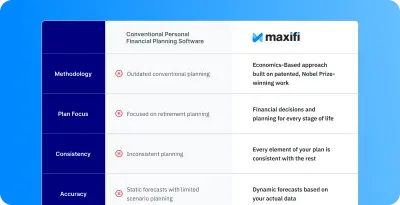
In more complex situations, comprehensive financial planning software such as MaxiFi can help illustrate how coordination across income, taxes, Social Security, savings, and spending shapes long term flexibility, placing FIRE numbers in context rather than treating them as final answers.
Financial Planning that Puts You in Control
Frequently Asked Questions About FIRE Numbers
Important Considerations
The discussion of FIRE numbers and calculators reflects current understanding of retirement planning concepts and commonly used assumptions as of 2026, where relevant. The examples and scenarios referenced are illustrative and intended to explain how FIRE targets are typically calculated, not to suggest specific actions. In practice, retirement outcomes vary widely based on individual circumstances, including health and longevity, the mix and timing of income sources, tax treatment, and evolving spending patterns over time.
Long term financial independence involves tradeoffs and uncertainty rather than a single correct answer. Simplified rules, assumptions, and calculators can be helpful for understanding basic relationships, but they may overlook important interactions across income, taxes, benefits, and spending. In more complex situations, comprehensive financial planning software such as MaxiFi can be used to model how these elements interact over time, helping place FIRE numbers in a broader planning context without reducing decisions to a single target.
Disclaimer
This article provides general educational information only and does not constitute legal, tax, or estate planning advice. Beneficiary designations, estate laws, and tax regulations vary significantly by state, account type, and individual circumstances. The information presented here is not intended to be a substitute for personalized legal or financial advice from qualified professionals such as estate planning attorneys, tax advisors, or financial planners. Beneficiary rules are subject to change and can have significant legal and tax implications. Before designating, changing, or making decisions about beneficiaries, you should consult with appropriate professionals who can evaluate your specific situation and applicable state and federal laws.