- FeaturesFeaturesHow it WorksUnderstand the MaxiFi features that help you build your lifetime planRoth Conversion OptimizerMaxiFi helps you optimize conversions and reduce taxesUse CasesHow can you put MaxiFi to use?Life Insurance Contingency PlanningGet peace of mind from life insurance recommendations tailored for youLiving Standard Monte CarloManage your living standard risk with confidence

- ServicesServicesOverviewChoose the right level of support for your plan and needsFlight CheckGet off the ground with comprehensive guidanceCo-PilotElevate your financial plan with one of MaxiFi’s certified financial plannersConcierge ServicePersonal, expert support to make the most of your financial plan
 Flight Check ServiceAsk your questions and make sure your plan is ready for take off with a MaxiFi expertLearn More
 - ResourcesResourcesWebinars and PodcastsExpert tips and guides to help you get the maximum from MaxiFiArticlesIn-depth commentary on the financial planning landscapeBooksFrom the world-renowned economist behind MaxiFiBlogInsights to help you optimize your financesFAQYour most pressing questions answeredFinancial GlossaryKey financial concepts explained in detail

- Why MaxiFiMaxiFiEconomics-Based PlanningHow MaxiFi's economics approach gives you a clear view of your financesCase StudiesReal stories about how MaxiFi helps users make smarter decisionsTestimonialsMaxiFi is trusted by households and experts for clarity and confidenceHow MaxiFi ComparesWith so many tools out there, how do you know MaxiFi is right for you?Press and ReviewsRead expert commentary and critical acclaim for MaxiFi
- Pricing
- AboutCompanyOur VisionThe best person to take control of your financial future is youMedia ResourcesLogos, background information, and media contactsFounder and AdvisorsMeet Laurence Kotlikoff and the visionary MaxiFi teamAffiliate ProgramShare MaxiFi with your audience to help them take control of their financesCareersWhy working at MaxiFi is rewarding, empowering, and impactfulContactQuestions or feedback? Get in touch with the MaxiFi team

Life Insurance Needs in Retirement: Coverage Planning Guide
As retirement approaches, many households begin reassessing financial tools they once relied on during their working years. Life insurance is often one of the most uncertain areas in that review. Policies purchased decades earlier may be nearing expiration, employer coverage may be ending, and assumptions about income replacement may no longer apply. In that context, interest in a life insurance calculator often increases, not because people want a quick answer, but because people want a clearer way to frame the question of coverage in retirement.
This topic matters because life insurance plays a different role once regular earnings stop. During working years, coverage is commonly tied to replacing paychecks or supporting dependents through peak earning periods. In retirement, the focus shifts toward protecting a surviving spouse, managing cash flow disruptions, addressing estate obligations, and preserving living standards over an uncertain lifespan. These needs vary widely across households, which makes simplified formulas and one size fits all approaches less informative at this stage of life.
This guide explains how life insurance needs are typically evaluated in retirement and what a life insurance calculator is designed to measure. It explores how insurance planning intersects with survivor income needs, taxes, and estate considerations, and why coverage amounts can differ dramatically even among households with similar net worth. The discussion also reviews common approaches such as standalone calculators, term versus permanent insurance, and income replacement assumptions, highlighting where each provides insight and where limitations emerge.
Rather than presenting coverage rules or recommendations, the goal is to help readers understand the structure of the problem. Life insurance in retirement is not about hitting a universal target. It is about understanding tradeoffs, identifying risks that remain after retirement, and recognizing how insurance fits into a broader financial system that includes spending needs, taxes, and long term coordination across assets.

Key Takeaways
- Life insurance needs often change significantly in retirement because earned income may stop, while survivor expenses, taxes, and estate obligations can remain.
- A life insurance calculator is designed to estimate potential coverage gaps, but its results depend heavily on assumptions about spending, taxes, and survivor needs.
- In retirement, insurance planning is less about replacing a paycheck and more about maintaining a surviving household’s living standard.
- Two households with similar assets can require very different coverage amounts based on how income sources, taxes, and withdrawal timing interact.
- Term insurance that was appropriate during working years may expire or become more expensive in retirement, requiring a reassessment of its role.
- Permanent insurance is sometimes used to address estate liquidity, survivor protection, or specific legacy goals rather than income replacement alone.
- Simplified coverage formulas can overlook critical factors such as taxes, asset location, and how long a surviving spouse may need support.
- Retirement insurance needs are closely tied to overall financial coordination, including spending plans, Social Security benefits, and tax structure.
- Standalone calculators can provide a useful starting point, but they do not model how insurance interacts with the rest of a household’s financial system.
- Insurance decisions in retirement often involve tradeoffs between coverage cost, risk reduction, and flexibility over time.
- Life insurance is most effective when evaluated as part of an integrated financial plan rather than as an isolated product decision.
How Life Insurance Needs Change in Retirement
Retirement changes the role life insurance plays within a household’s financial structure. During working years, coverage is often tied closely to replacing employment income or supporting dependents through peak earning periods. Once retirement begins, those assumptions shift. Paychecks may stop, but expenses do not disappear, and financial responsibilities often extend well beyond the working years.
In retirement, the primary risk life insurance addresses is no longer the loss of earned income, but the disruption that occurs if one spouse dies earlier than expected. Survivor needs may include maintaining housing, covering ongoing living expenses, managing taxes, and addressing estate obligations. These needs can persist for many years, especially when one spouse lives significantly longer than the other.
At the same time, some risks decline in retirement. Children may be financially independent, major debts may be reduced, and savings may be more substantial. Other risks increase. Longevity uncertainty grows, healthcare costs become less predictable, and the timing of income sources such as pensions or Social Security becomes more consequential.
Because of these changes, life insurance needs in retirement become more individualized. Coverage amounts that made sense at age forty or fifty may be too high, too low, or misaligned with actual risks later in life. Retirement planning shifts the focus away from broad income replacement formulas and toward understanding how a survivor’s living standard would be affected under different scenarios.
What a Life Insurance Needs Calculator Is Designed to Measure
A life insurance needs calculator is intended to help estimate potential financial gaps that could arise if one household member dies. These tools are designed to organize assumptions about income, expenses, assets, and liabilities into a simplified framework. Understanding what they measure, and what they do not, is essential when using them in retirement planning.
Income Replacement and Survivor Protection
Most insurance calculators begin with an income replacement concept. They estimate how much income a surviving spouse might lose as a result of the death of his or her partner and how much capital would be required to offset that loss. In retirement, this often translates into identifying gaps between expected survivor income sources and projected survivor expenses.
These estimates typically assume a steady replacement amount over a defined period. While this can be useful as a starting point, it relies on static assumptions that may not reflect how income sources actually change after retirement. Survivor income may increase or decrease depending on benefit structures, tax treatment, and the timing of withdrawals from different accounts.
As a result, income replacement insurance logic can oversimplify the problem. It may not fully account for changes in spending patterns, differences in tax exposure, or the way assets are drawn down over time. The result is an estimate that highlights potential risk, but does not explain how that risk interacts with the rest of the financial system.
One Time Needs vs Ongoing Living Standards
Insurance calculators also attempt to capture one time financial needs. These can include funeral expenses, outstanding debts, final tax obligations, and estate settlement costs. Addressing these items can be important, particularly when liquidity is limited or assets are not easily accessed.
However, one time needs are only part of the picture. Ongoing living standards often represent a much larger and longer lasting concern. A surviving spouse may need support for decades, not just months. Calculators that emphasize lump sum obligations without modeling long term cash flow can understate the importance of sustained income coordination.
Distinguishing between short term obligations and lifetime support helps clarify the purpose insurance is meant to serve. It shifts attention from settling accounts to maintaining financial stability over an uncertain horizon.
Common Approaches to Estimating Retirement Coverage
There are several commonly discussed approaches to estimating life insurance coverage in retirement. Each offers insight into part of the problem, but none provides a complete answer on its own.
Rules of Thumb and Simplified Multiples
Rules of thumb often express coverage needs as a multiple of income or expenses. These heuristics are easy to understand and quick to apply, which explains their popularity. They can help frame the scale of the question by providing an initial reference point.
In retirement, however, these simplified multiples tend to break down. Income streams become more complex, tax treatment varies across assets, and spending patterns evolve over time. Applying a fixed multiple assumes uniform circumstances that rarely exist in practice.
As a result, these approaches are best viewed as educational illustrations rather than decision frameworks. They explain how people often think about coverage, but they do not account for the interactions that determine real outcomes.
Standalone Life Insurance Calculators
Standalone life insurance needs calculators offer automation and convenience. They prompt users to enter basic information and produce an estimated coverage amount based on predefined formulas. For many households, this can be a helpful way to organize thinking around survivor risk.
The limitation of these tools is their narrow scope. They typically do not model how insurance interacts with taxes, withdrawal sequencing, or changes in spending over time. They also treat insurance decisions independently from other financial choices.
As a result, while calculators can highlight potential exposure, they do not explain how insurance fits into a coordinated retirement plan. They answer a narrow question, not the broader planning challenge.
Term vs Whole Life and Other Permanent Insurance in Retirement Context
Different types of life insurance function differently after retirement. Understanding these distinctions helps clarify how each policy type may or may not align with retirement goals.
Term Insurance After Retirement
Term insurance is often purchased during working years because it offers high coverage at relatively low cost. In retirement, term policies may approach expiration or experience significant premium increases. Employer sponsored coverage may also end, reducing available protection.
These changes can create gaps if coverage ends unexpectedly or becomes unaffordable. Evaluating term insurance in retirement often involves understanding expiration risk and how coverage loss would affect survivor security.
Whole Life and Other Permanent Insurance in Estate Planning
Permanent life insurance, including whole life and universal life policies, is sometimes used in retirement to address longer term needs. Survivorship policies, for example, may be structured to provide liquidity for estate settlement or to support a surviving spouse.
These policies can play a role in managing estate taxes, equalizing inheritances, or providing predictable capital at death. Their effectiveness depends on how they are coordinated with other assets rather than on policy type alone.
Why Coverage Amounts Vary Widely Between Households
One of the defining features of retirement insurance planning is variability. Households with similar net worth or income levels can arrive at very different coverage needs.
Taxes, Asset Location, and Survivor Cash Flow
After tax income matters more than gross balances. Assets held in taxable, tax deferred, and tax free accounts produce different cash flow outcomes for survivors. Withdrawal timing and tax rates can materially change how much support assets provide.
Two households with identical asset values can experience very different survivor cash flow depending on how assets are structured. Insurance needs reflect those differences rather than headline numbers.
Longevity Risk and Contingencies
Longevity adds another layer of uncertainty. One spouse may live significantly longer than expected, increasing the duration over which support is required. At the same time, some expenses may decline after death, while others increase due to healthcare needs.
Contingencies also matter. Retirement contributions may stop, spending patterns may adjust, and healthcare costs may change. Insurance planning that accounts for these possibilities recognizes that coverage needs are shaped by uncertainty rather than fixed outcomes.
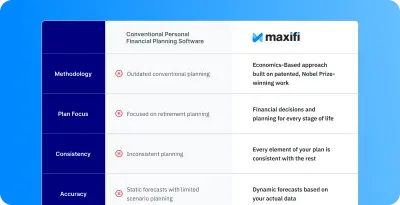
Understanding these factors reinforces a central point. Life insurance needs in retirement are not universal. They emerge from the interaction of income sources, taxes, assets, spending, and time rather than from a single formula or benchmark. Some comprehensive financial planning software is designed to model these interactions by evaluating survivor living standards, taxes, withdrawal patterns, and longevity together, instead of estimating coverage in isolation. This type of coordinated analysis helps illustrate why coverage amounts can differ widely even among households with similar assets or income.
Financial Planning that Puts You in Control
Frequently Asked Questions About Life Insurance in Retirement
Important Considerations
Life insurance needs in retirement depend on how a household’s financial system functions after the death of one spouse, not just on asset balances or policy face values. Survivor income sources, tax treatment, spending patterns, and longevity all influence whether existing resources can sustain living standards over time. Because these factors vary widely, coverage needs that appear similar on paper can lead to very different outcomes in practice.
Estimates and examples discussed in this article are illustrative and are intended to explain how life insurance considerations interact with retirement planning, not to recommend specific coverage levels or policy types. Simplified calculators, rules of thumb, or single-scenario assumptions may overlook important interactions across taxes, withdrawals, Social Security benefits, and long term spending needs. In more complex situations, comprehensive financial planning software such as can be used to model these interactions across income, taxes, assets, and survivor timelines to better understand tradeoffs and uncertainty.
Disclaimer
This article provides general educational information only and does not constitute legal, tax, or estate planning advice. Beneficiary designations, estate laws, and tax regulations vary significantly by state, account type, and individual circumstances. The information presented here is not intended to be a substitute for personalized legal or financial advice from qualified professionals such as estate planning attorneys, tax advisors, or financial planners. Beneficiary rules are subject to change and can have significant legal and tax implications. Before designating, changing, or making decisions about beneficiaries, you should consult with appropriate professionals who can evaluate your specific situation and applicable state and federal laws.