- FeaturesFeaturesHow it WorksUnderstand the MaxiFi features that help you build your lifetime planRoth Conversion OptimizerMaxiFi helps you optimize conversions and reduce taxesUse CasesHow can you put MaxiFi to use?Life Insurance Contingency PlanningGet peace of mind from life insurance recommendations tailored for youLiving Standard Monte CarloManage your living standard risk with confidence

- ServicesServicesOverviewChoose the right level of support for your plan and needsFlight CheckGet off the ground with comprehensive guidanceCo-PilotElevate your financial plan with one of MaxiFi’s certified financial plannersConcierge ServicePersonal, expert support to make the most of your financial plan
 Flight Check ServiceAsk your questions and make sure your plan is ready for take off with a MaxiFi expertLearn More
 - ResourcesResourcesWebinars and PodcastsExpert tips and guides to help you get the maximum from MaxiFiArticlesIn-depth commentary on the financial planning landscapeBooksFrom the world-renowned economist behind MaxiFiBlogInsights to help you optimize your financesFAQYour most pressing questions answeredFinancial GlossaryKey financial concepts explained in detail

- Why MaxiFiMaxiFiEconomics-Based PlanningHow MaxiFi's economics approach gives you a clear view of your financesCase StudiesReal stories about how MaxiFi helps users make smarter decisionsTestimonialsMaxiFi is trusted by households and experts for clarity and confidenceHow MaxiFi ComparesWith so many tools out there, how do you know MaxiFi is right for you?Press and ReviewsRead expert commentary and critical acclaim for MaxiFi
- Pricing
- AboutCompanyOur VisionThe best person to take control of your financial future is youMedia ResourcesLogos, background information, and media contactsFounder and AdvisorsMeet Laurence Kotlikoff and the visionary MaxiFi teamAffiliate ProgramShare MaxiFi with your audience to help them take control of their financesCareersWhy working at MaxiFi is rewarding, empowering, and impactfulContactQuestions or feedback? Get in touch with the MaxiFi team

Lifetime Tax Optimization: Coordinating Social Security, Roth Conversions, and RMDs
Taxes are one of the largest and most persistent costs retirees face, yet they are often planned for in fragments. Many people focus on reducing taxes in the current year without fully accounting for how today’s decisions affect taxes decades later. In retirement, this approach can quietly increase total taxes paid over a lifetime, even when each individual year appears well managed. As incomes shift from wages to Social Security, withdrawals, and required distributions, tax outcomes become more dependent on timing and coordination than on any single strategy.
Lifetime tax optimization starts from a different premise. Instead of asking how to minimize taxes this year, it asks how taxes accumulate over an entire retirement. Decisions about when to claim Social Security, when or whether to do Roth conversions, and how required minimum distributions unfold, are deeply connected. A move that lowers taxes in one phase of retirement can raise them sharply later by increasing the taxation of benefits, pushing income into higher brackets, or compressing distributions into fewer years.
This topic matters because retirement tax planning is no longer static. Longevity uncertainty, changing income sources, and policy risk mean that isolated tax decisions can have unintended consequences. Lifetime tax optimization does not rely on rules of thumb or one size fits all answers. It focuses on understanding interactions, tradeoffs, and how coordinated planning can change outcomes over time. This guide explains how Social Security, Roth conversions, and RMDs interact, why annual tax planning often falls short, and how economics based planning approaches taxes as a system rather than a series of independent choices.

Key Takeaways
- Lifetime tax optimization focuses on total taxes paid over retirement, not minimizing taxes in a single year
- Annual tax planning can unintentionally increase lifetime taxes by shifting income into later, higher tax years
- Social Security plays a central role in tax outcomes through benefit taxation and income coordination
- Roth conversion timing affects not only current taxes but also future Social Security taxation and RMD levels
- Required minimum distributions can create a deferred tax cliff if not considered early
- Coordinating Social Security, Roth conversions, and withdrawals matters more than optimizing any one decision
- Tax efficient retirement planning depends on how income sources interact over time, not just marginal rates
- Outcomes vary widely based on longevity, marital status, account mix, and spending patterns
- Policy and tax law uncertainty make rigid rules less reliable over long retirements
- Simplified tax strategies often fail because they ignore system level interactions
- Comprehensive tax planning looks at cash flow, taxes, and timing together rather than in isolation
- Economics based planning evaluates lifetime tax tradeoffs without relying on prescriptive conclusions
Why Annual Tax Planning Breaks Down in Retirement
Annual tax planning works reasonably well during working years because income is relatively stable and predictable. Wages arrive regularly, deductions are familiar, and tax decisions tend to repeat from year to year. Retirement disrupts this pattern. Income becomes uneven, sources shift over time, and the tax impact of decisions often appears years or decades after they are made.
Many retirees rely heavily on tax deferred accounts that delay taxes rather than eliminate them. Required minimum distributions, benefit taxation, and withdrawals from different account types can cause taxable income to spike later in retirement even if taxes appear low early on. Annual optimization that focuses on staying within a preferred bracket today can unintentionally push income into higher brackets later when flexibility is reduced.
This is why annual tax planning often breaks down in retirement. Decisions made in isolation may lower taxes in one year while increasing lifetime taxes overall. Without a broader view, it is easy to underestimate how deferred taxes accumulate and how income compression later in life can change marginal rates, benefit taxation, and overall tax exposure.
What Lifetime Tax Optimization Actually Means
Lifetime tax optimization looks beyond individual tax years and focuses on total taxes paid across an entire retirement. The objective is not to minimize taxes at every point in time, but to understand how taxes add up as income sources evolve and interact.
This approach treats taxes as a cumulative outcome rather than a series of annual problems. It recognizes that Social Security, Roth conversions, and required distributions influence each other over long horizons. A decision that raises taxes today may reduce total taxes later by preventing larger tax spikes in the future. Conversely, avoiding taxes now can lead to higher lifetime taxes if income becomes concentrated into fewer years.
Annual vs Lifetime Tax Planning
Annual tax planning asks whether a move lowers this year’s tax bill. Lifetime tax optimization asks how that move changes taxes across decades. The difference is subtle but consequential. Minimizing income in a single year may increase required distributions later or raise the portion of Social Security benefits subject to tax.
Coordination matters more than timing individual actions. Without coordination, well intentioned tax moves can work against each other. Lifetime tax optimization shifts the focus from tactical savings to structural outcomes.
How Social Security Interacts With Lifetime Tax Planning
Social Security affects lifetime tax outcomes in ways that extend far beyond the benefit amount. Benefit taxation depends on other income sources, which means withdrawals and conversions can increase the taxable portion of benefits even if Social Security itself does not change.
Claiming timing interacts with tax planning because it influences when Social Security enters the income stream. Introducing benefits earlier or later can change how provisional income is calculated and how other withdrawals are layered on top. These interactions can raise marginal tax rates unexpectedly when combined with tax deferred withdrawals or conversions.
Social Security tax coordination is therefore not about optimizing the benefit in isolation. It is about understanding how benefit timing changes the tax treatment of all income sources over time. Without this coordination, retirees may underestimate how much of their Social Security becomes taxable and how that taxation compounds across years.
Roth Conversion Timing and Its Tradeoffs
Roth conversions are often discussed as a way to reduce future taxes, but they are fundamentally timing decisions. Converting assets moves taxes from the future into the present. Whether that tradeoff is favorable depends on how it affects income interactions over time.
Conversions increase taxable income in the year they occur. This can influence benefit taxation, Medicare premiums, and marginal rates. At the same time, conversions may reduce future required distributions and smooth income later in retirement. The benefit is not automatic and depends on how the conversion fits into the broader tax picture.
When Roth Conversions Help and When They Can Backfire
Roth conversions can help when they prevent taxable income from being concentrated into fewer years at higher marginal tax rates later in retirement. They can backfire when they increase current income enough to trigger additional Social Security benefit taxation or higher Medicare IRMAA surcharges. The same conversion amount can have very different effects depending on timing, income mix, and household circumstances.
This variability highlights why Roth conversion timing cannot be evaluated in isolation. The question is not whether conversions are good or bad, but how they interact with Social Security, withdrawals, and future distributions.
RMDs and the Deferred Tax Cliff
Required minimum distributions represent deferred taxes coming due. For many retirees, these distributions arrive after years of tax deferral, often at a time when other income sources are already active.
When planning is delayed, RMDs can create a deferred tax cliff. Income that was once manageable becomes compressed into fewer years, raising marginal rates and increasing the taxable portion of Social Security benefits. The result can be higher taxes even if spending remains unchanged.
Understanding RMD tax planning requires looking ahead. The impact is not limited to the year distributions begin. It affects tax outcomes throughout the remaining retirement and interacts with earlier decisions around conversions and claiming.
Coordinating Taxes Across Income Sources
Effective tax planning in retirement requires integrating multiple income streams. Social Security, Roth conversions, taxable withdrawals, and required distributions all influence one another. Treating them separately often leads to unintended consequences.
Integrating tax strategies means recognizing that income sources stack, overlap, and compound. A withdrawal strategy that looks efficient on its own may raise taxes elsewhere. Coordination helps reveal how decisions affect total income, benefit taxation, and marginal rates across time.
This system level view explains why isolated decisions fail. Taxes are not determined by any single action, but by how actions combine across years.
Why Lifetime Tax Outcomes Vary So Widely
Lifetime tax outcomes differ dramatically from household to household. Health and longevity influence how long taxes are paid and when income peaks. Marital status affects filing status and survivor outcomes. Account mix determines how much income is taxable, tax deferred, or tax free.
Policy risk adds another layer of uncertainty. Tax laws change, thresholds adjust, and benefit rules evolve. Spending patterns also matter. Higher or lower spending changes withdrawal needs and income timing.
Because these factors interact, no two households face the same tax path. This variation is why fixed rules and shortcuts struggle to capture reality.
How Economics-Based Planning Models Lifetime Taxes
Economics-based planning evaluates lifetime tax optimization by modeling how income, taxes, spending, and timing interact under uncertainty. Rather than focusing on single year outcomes, it examines how decisions shape cumulative taxes and cash flow across retirement.
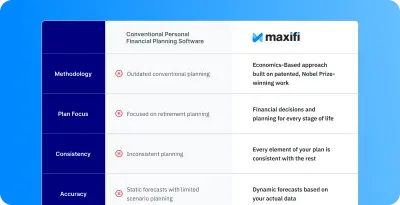
Conventional financial planning tools often fail here because they rely on static projections that isolate individual variables. They may show projected balances or marginal rates without connecting them to spending or benefit taxation. System-level modeling links these elements, making it possible to see whether a tax decision reduces lifetime taxes or simply shifts them.
MaxiFi’s economics-based, comprehensive financial planning software illustrates this approach by modeling coordination across Social Security, Roth conversions, withdrawals, and required distributions over time. The value lies in understanding tradeoffs and exposure rather than predicting outcomes.
Common Misunderstandings About Lifetime Tax Optimization
Lifetime tax optimization is not about paying the least tax possible every year. It is not about predicting future tax laws or finding a perfect strategy that works for everyone. It also does not eliminate uncertainty.
The goal is understanding, not certainty. By focusing on interactions and cumulative effects, lifetime tax optimization helps clarify how decisions influence long term outcomes. It provides structure for evaluating tradeoffs rather than rules for action.
Lifetime tax optimization works best when viewed as a framework for reasoning about taxes across time, not as a shortcut to guaranteed savings.
Financial Planning that Puts You in Control
Frequently Asked Questions About Lifetime Tax Optimization
Important Considerations
The discussion in this article reflects current understanding of lifetime tax optimization and economics-based retirement planning as of 2026. The examples and scenarios described are illustrative and are intended to explain how Social Security, Roth conversions, and required minimum distributions interact over time. They are not recommendations or prescriptions. Retirement tax outcomes vary widely based on factors such as health and longevity, marital status, the mix and timing of income sources, exposure to taxes and policy changes, and individual spending patterns.
Decisions involving lifetime tax coordination involve tradeoffs and uncertainty rather than single right answers. Simplified assumptions or rule-based approaches can overlook important interactions between benefits, withdrawals, and tax thresholds that shape cumulative tax exposure. Approaches that evaluate these elements together can help clarify how different timing choices affect lifetime taxes. For example, comprehensive financial planning software such as MaxiFi can model these interactions across income, taxes, and spending to illustrate tradeoffs without implying guaranteed outcomes.
Disclaimer
This article provides general educational information only and does not constitute legal, tax, or estate planning advice. Beneficiary designations, estate laws, and tax regulations vary significantly by state, account type, and individual circumstances. The information presented here is not intended to be a substitute for personalized legal or financial advice from qualified professionals such as estate planning attorneys, tax advisors, or financial planners. Beneficiary rules are subject to change and can have significant legal and tax implications. Before designating, changing, or making decisions about beneficiaries, you should consult with appropriate professionals who can evaluate your specific situation and applicable state and federal laws.