- FeaturesFeaturesHow it WorksUnderstand the MaxiFi features that help you build your lifetime planRoth Conversion OptimizerMaxiFi helps you optimize conversions and reduce taxesUse CasesHow can you put MaxiFi to use?Life Insurance Contingency PlanningGet peace of mind from life insurance recommendations tailored for youLiving Standard Monte CarloManage your living standard risk with confidence

- ServicesServicesOverviewChoose the right level of support for your plan and needsFlight CheckGet off the ground with comprehensive guidanceCo-PilotElevate your financial plan with one of MaxiFi’s certified financial plannersConcierge ServicePersonal, expert support to make the most of your financial plan
 Flight Check ServiceAsk your questions and make sure your plan is ready for take off with a MaxiFi expertLearn More
 - ResourcesResourcesWebinars and PodcastsExpert tips and guides to help you get the maximum from MaxiFiArticlesIn-depth commentary on the financial planning landscapeBooksFrom the world-renowned economist behind MaxiFiBlogInsights to help you optimize your financesFAQYour most pressing questions answeredFinancial GlossaryKey financial concepts explained in detail

- Why MaxiFiMaxiFiEconomics-Based PlanningHow MaxiFi's economics approach gives you a clear view of your financesCase StudiesReal stories about how MaxiFi helps users make smarter decisionsTestimonialsMaxiFi is trusted by households and experts for clarity and confidenceHow MaxiFi ComparesWith so many tools out there, how do you know MaxiFi is right for you?Press and ReviewsRead expert commentary and critical acclaim for MaxiFi
- Pricing
- AboutCompanyOur VisionThe best person to take control of your financial future is youMedia ResourcesLogos, background information, and media contactsFounder and AdvisorsMeet Laurence Kotlikoff and the visionary MaxiFi teamAffiliate ProgramShare MaxiFi with your audience to help them take control of their financesCareersWhy working at MaxiFi is rewarding, empowering, and impactfulContactQuestions or feedback? Get in touch with the MaxiFi team

MaxiFi vs ChatGPT for Financial Planning: Why AI Can't Replace Comprehensive Software
The rapid rise of generative AI has changed how people search for and consume financial information. Questions that once required lengthy research can now be answered in seconds through conversational tools like ChatGPT, Gemini, Perplexity, and Claude. As a result, interest in AI-assisted financial planning using tools like ChatGPT has grown quickly. Many individuals are experimenting with AI to explore retirement scenarios, understand financial concepts, or test high-level ideas about their future finances.
This shift is understandable. AI tools are accessible, fast, and capable of explaining complex topics in plain language. However, the growing use of AI for financial planning has also blurred an important distinction. Explaining financial concepts is not the same as constructing a financial plan. Planning requires consistent assumptions, verified inputs, and the ability to coordinate decisions across time, uncertainty, and multiple financial systems. AI can help a reader understand financial concepts, but understanding a concept is not the same as building a plan that coordinates income, taxes, benefits, and spending across a lifetime.
This distinction is especially relevant when comparing MaxiFi and ChatGPT. MaxiFi is comprehensive financial planning software built on an economics-based framework designed to model lifetime outcomes. ChatGPT is a generative AI system designed to generate responses based on patterns in language. Both can be useful, but they are designed for fundamentally different purposes.
This guide examines MaxiFi vs ChatGPT by looking at what each tool is built to do. It explains what AI tools can do well, where their limitations emerge in financial planning contexts, and why comprehensive software remains necessary for modeling long-term financial decisions. ChatGPT generates responses from language patterns. MaxiFi solves a lifetime planning problem by coordinating taxes, benefits, spending, and income across every future year. The goal is not to dismiss AI, but to clarify what it can and cannot replace.

Key Takeaways
- Interest in AI financial planning has increased as tools like ChatGPT become more accessible and widely used.
- ChatGPT is designed to generate explanations and explore ideas, not to build or maintain structured financial plans.
- Retirement planning involves coordination across income, taxes, Social Security, savings, spending, and longevity risk.
- AI tools do not maintain persistent assumptions or verified household data across time.
- Financial planning requires consistent inputs and repeatable logic, not variable responses.
- Economics-based planning calculates the living standard a household can maintain, coordinating income, taxes, benefits, and spending across a lifetime rather than treating each decision in isolation.
- ChatGPT outputs can change based on prompts, framing, or context, creating inconsistency risk.
- Comprehensive software is built to model systems, constraints, and uncertainty in a unified way. AI generates a fresh response to each prompt without maintaining that underlying framework.
- AI can support learning and understanding but cannot replace structured planning frameworks.
- MaxiFi and ChatGPT serve different roles and are not substitutes for one another.
- Using AI for explanation does not eliminate the need for software that models outcomes.
- Understanding these differences helps set realistic expectations about what AI can and cannot do in financial planning.
Why AI Is Being Used for Financial Planning
The growing use of AI tools for financial planning reflects how people now search for information and make sense of complex topics. Tools like ChatGPT are easy to access, respond instantly, and allow users to ask questions in natural language rather than navigating structured forms or technical menus. For individuals who are exploring retirement planning concepts for the first time, this conversational approach can feel intuitive and low friction.
AI tools also appeal to curiosity. Many users want to test whether a general purpose AI can answer questions traditionally handled by financial software or professionals. Others use AI to validate ideas they already have or to quickly summarize unfamiliar concepts. In that sense, turning to ChatGPT for planning related questions is a reasonable behavior, especially at an early learning stage.
What often gets blurred is the difference between asking questions and building a plan. AI tools excel at responding to prompts, but financial planning requires continuity, consistency, and coordination across many moving parts. Understanding why people are drawn to AI helps frame the comparison without assuming that AI is intended to replace structured planning systems.
What ChatGPT Can Do Well in Financial Contexts
ChatGPT performs well when the task involves explanation rather than the actual construction of a financial plan. It can describe financial concepts, outline general rules, and help users think through hypothetical situations at a high level. For many users, this makes financial topics feel less intimidating and more approachable.
In planning contexts, ChatGPT is often used as a starting point. It helps users clarify terminology, understand how different concepts relate to one another, and explore broad tradeoffs without committing to specific assumptions. This role is valuable, particularly for learning and orientation.
The strength of ChatGPT lies in its ability to generate coherent explanations quickly. It is not designed to verify data, maintain consistency across sessions, or produce repeatable outcomes based on fixed inputs. Recognizing this distinction helps place its usefulness in the right context.
Explanation, Education, and Scenario Exploration
ChatGPT is effective at explaining how financial systems generally work. It can walk through ideas such as retirement income sources, tax considerations, or the basic structure of Social Security. It can also discuss scenarios in a conceptual way, helping users think about how different choices might affect outcomes in theory.
These explanations are informational rather than structural. ChatGPT does not track household specific data over time or enforce constraints across decisions. Each response stands on its own, shaped by the prompt rather than by a persistent model. This makes it useful for education and exploration, but not for constructing or maintaining a financial plan.
The Structural Limits of AI for Financial Planning
Financial planning is not a conversation. It is a constrained system that depends on verified inputs, consistent assumptions, and repeatable logic. This is where the limitations of AI tools become more apparent.
AI systems generate responses based on language patterns rather than on a fixed planning framework. They do not enforce internal consistency across decisions, nor do they evaluate tradeoffs within a formal model. As a result, outputs can vary even when questions are similar.
These limitations do not make AI unhelpful, but they do define its boundaries. Understanding those boundaries is essential when comparing AI tools with comprehensive planning software.
Lack of Persistent State and Verified Inputs
One of the key challenges with using AI for financial planning is that the tool does not maintain a structured, verified record of a household's finances over time. Some AI tools offer memory features or allow users to restate prior inputs, but these are approximations rather than a controlled dataset. The tool may recall some details, miss others, or carry forward an assumption the user corrected in an earlier session. Financial planning depends on a complete, consistent set of inputs that the user can inspect and update deliberately, not on a best-effort reconstruction from prior conversations.
This creates an inconsistency risk. Small changes in wording can lead to different responses, and assumptions may shift without being explicit. Financial planning depends on controlled inputs and traceable logic, which AI tools are not designed to enforce.
No System-Level Coordination Across Time
Retirement planning requires coordination across income timing, taxes, Social Security, spending patterns, and longevity uncertainty. These elements interact over decades, and changes in one area can alter outcomes elsewhere.
AI tools do not model these interactions as a system. They can describe relationships conceptually, but they do not simulate how decisions compound across time within a single framework. Without system-level coordination, it becomes difficult to evaluate long-term sustainability or tradeoffs reliably.
Data Privacy and Sensitive Financial Information
Financial planning requires sensitive inputs such as account balances, tax details, and Social Security benefit amounts. Most consumer AI plans, including paid individual subscriptions, use conversation data to train future versions of the model by default. That means the financial details a user types into a chat can be absorbed into the provider's training dataset. Opting out is possible on most platforms, but it requires finding and changing the setting manually.
Dedicated financial planning software that runs on a user's own household data within a structured application does not face this problem in the same way, because the data exists to serve the plan rather than to train a language model.
Why Economics-Based Planning Requires Software, Not AI Conversation
Economics-based planning treats retirement as a lifetime optimization problem constrained by uncertainty and limited resources. It depends on formal rules, consistent assumptions, and the ability to model how decisions interact across time.
This type of planning cannot be reduced to a series of questions and answers. It requires software that can apply the same logic repeatedly, track assumptions, and produce comparable outcomes under different scenarios. Conversation alone does not provide the structure needed to support this process.
The distinction is structural, not technological. AI can explain economic principles, but applying those principles consistently requires a planning engine designed for that purpose.
Lifetime Constraints, Tradeoffs, and Uncertainty
A central insight of economics-based planning is that choices involve tradeoffs across time. Spending more today affects options later. Claiming income earlier changes tax exposure and future flexibility. Longevity uncertainty means plans must work across a range of possible outcomes.
These dynamics require a framework that can model constraints and uncertainty explicitly. Point in time answers cannot capture how decisions ripple through a lifetime plan. Software is necessary to evaluate these interactions in a coherent and repeatable way.
How MaxiFi Approaches Financial Planning Differently
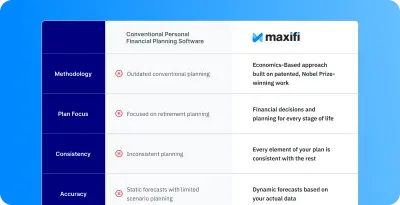
MaxiFi is designed as comprehensive financial planning software rather than a conversational tool. Its role is to model coordination across income, taxes, Social Security, savings, and spending within a single framework. The emphasis is on methodology, not on generating responses.
Instead of answering isolated questions, MaxiFi evaluates how assumptions interact across time. This allows users to see tradeoffs, test scenarios under consistent logic, and understand how changes in one area affect outcomes elsewhere. The focus is on system-level coherence rather than on individual explanations.
This approach reflects the requirements of economics-based planning. It is built to apply structured logic consistently rather than to adapt responses to conversational prompts.
AI vs Financial Software: Different Tools for Different Jobs
AI tools and financial planning software are not substitutes for one another. They serve different purposes and address different needs. AI excels at explanation, exploration, and lowering the barrier to understanding complex topics. Financial software excels at modeling, coordination, and consistency.
Using AI to learn and ask questions can complement the use of planning software. Confusion arises when explanation is mistaken for planning or when conversational responses are treated as structured analysis. Recognizing the distinct roles of each tool helps set realistic expectations.
Common Misunderstandings About AI in Financial Planning
A common misunderstanding is that AI is inherently smarter than specialized software. Intelligence in financial planning comes from structure and consistency, not from conversational fluency. Another misconception is that AI can replace planners or planning systems entirely.
AI does not optimize outcomes, verify data, or manage uncertainty within a formal framework. It supports understanding but does not establish plans. Viewing AI as authoritative rather than supportive can lead to misplaced confidence.
Understanding these limitations does not diminish the value of AI. It clarifies where AI fits and where comprehensive planning software remains essential.
Financial Planning that Puts You in Control
Frequently Asked Questions About MaxiFi vs ChatGPT
Important Considerations
This discussion reflects current understanding of conversational AI tools and comprehensive financial planning software frameworks as of 2026. The examples and scenarios referenced are illustrative only and are intended to clarify how different approaches function, not to suggest particular actions or outcomes. AI capabilities and planning tools continue to evolve, and conclusions about their appropriate use depend on how they are applied rather than on labels alone.
Financial planning outcomes vary widely by individual circumstances, including health and longevity, income sources and timing, exposure to taxes and policy changes, and spending patterns over time. Long-term planning involves tradeoffs and uncertainty rather than single right answers. While AI tools can help explain concepts and frame questions, simplified assumptions or conversational responses may overlook important interactions across income, taxes, Social Security, and spending. Comprehensive financial planning software such as MaxiFi can model these interactions within a consistent framework, helping place high-level explanations in proper context without eliminating uncertainty.
Disclaimer
This article provides general educational information only and does not constitute legal, tax, or estate planning advice. Beneficiary designations, estate laws, and tax regulations vary significantly by state, account type, and individual circumstances. The information presented here is not intended to be a substitute for personalized legal or financial advice from qualified professionals such as estate planning attorneys, tax advisors, or financial planners. Beneficiary rules are subject to change and can have significant legal and tax implications. Before designating, changing, or making decisions about beneficiaries, you should consult with appropriate professionals who can evaluate your specific situation and applicable state and federal laws.