- FeaturesFeaturesHow it WorksUnderstand the MaxiFi features that help you build your lifetime planRoth Conversion OptimizerMaxiFi helps you optimize conversions and reduce taxesUse CasesHow can you put MaxiFi to use?Life Insurance Contingency PlanningGet peace of mind from life insurance recommendations tailored for youLiving Standard Monte CarloManage your living standard risk with confidence

- ServicesServicesOverviewChoose the right level of support for your plan and needsFlight CheckGet off the ground with comprehensive guidanceCo-PilotElevate your financial plan with one of MaxiFi’s certified financial plannersConcierge ServicePersonal, expert support to make the most of your financial plan
 Flight Check ServiceAsk your questions and make sure your plan is ready for take off with a MaxiFi expertLearn More
 - ResourcesResourcesWebinars and PodcastsExpert tips and guides to help you get the maximum from MaxiFiArticlesIn-depth commentary on the financial planning landscapeBooksFrom the world-renowned economist behind MaxiFiBlogInsights to help you optimize your financesFAQYour most pressing questions answeredFinancial GlossaryKey financial concepts explained in detail

- Why MaxiFiMaxiFiEconomics-Based PlanningHow MaxiFi's economics approach gives you a clear view of your financesCase StudiesReal stories about how MaxiFi helps users make smarter decisionsTestimonialsMaxiFi is trusted by households and experts for clarity and confidenceHow MaxiFi ComparesWith so many tools out there, how do you know MaxiFi is right for you?Press and ReviewsRead expert commentary and critical acclaim for MaxiFi
- Pricing
- AboutCompanyOur VisionThe best person to take control of your financial future is youMedia ResourcesLogos, background information, and media contactsFounder and AdvisorsMeet Laurence Kotlikoff and the visionary MaxiFi teamAffiliate ProgramShare MaxiFi with your audience to help them take control of their financesCareersWhy working at MaxiFi is rewarding, empowering, and impactfulContactQuestions or feedback? Get in touch with the MaxiFi team

Retirement Savings Projections: 401(k) and IRA Growth Planning
Planning for retirement often begins with a simple question. How much will today’s savings grow over time, and will it be enough to support future living standards. That question feels more urgent for many households as longer retirements, market uncertainty, and rising costs place greater pressure on personal savings. As a result, interest in using a retirement savings calculator has grown, not as a way to predict the future with precision, but as a way to understand how current decisions may shape long term outcomes.
This topic matters because retirement savings are rarely static. Contributions, investment returns, employer matches, and account types such as 401(k)s and IRAs interact over decades. Small differences in contribution rates, assumed returns, or savings timelines can lead to large differences in projected balances. For households trying to set realistic expectations, savings projections offer a structured way to explore how accumulation works and how sensitive results are to changes in assumptions. At the same time, projections are often misunderstood, because they focus on accumulation rather than sustainability. A projected balance shows how savings may grow, but it does not account for how long those savings must last, how withdrawals will be taxed, or how spending needs evolve in retirement once contributions stop and drawdowns begin.
This guide explains how retirement savings projections are typically constructed and what tools such as 401(k) growth calculators, IRA growth projections, and retirement account projection models are designed to measure. It examines the role of compound interest, contribution patterns, and employer matching, while also highlighting why projected account balances alone do not determine retirement security. The discussion focuses on understanding assumptions, limitations, and variability rather than presenting targets or recommendations.
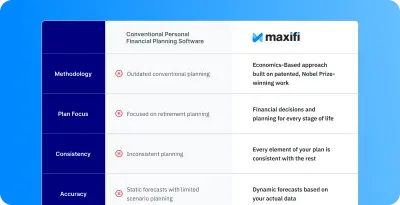
By framing retirement savings projections as planning inputs rather than promises, this article helps place calculators in their proper role. By framing retirement savings projections as planning inputs rather than promises, this article helps place calculators in their proper role. Most retirement savings calculators make free standing calculations that are not integrated into a comprehensive plan. They project account balances forward in isolation, without connecting accumulation to withdrawals, taxes, Social Security timing, or the coordination across income sources that determines how long savings actually last.
That distinction matters because a projected balance and a sustainable spending level are two different figures, and the gap between them is where most planning errors occur. These calculators are useful for exploring growth scenarios and tradeoffs, but they work best when their results are carried into a broader analysis that accounts for time, risk, and the interaction between all of a household's retirement resources.

Key Takeaways
- Retirement savings calculators project account balances over time, not future retirement income or spending capacity.
- Projected balances are driven by assumptions about contributions, returns, and time, which means small input changes can produce large differences in outcomes.
- Compound interest projections illustrate growth mechanics, but they do not account for market volatility, sequence risk, or changing investment behavior.
- Employer matches can materially affect projected balances, yet their impact depends on vesting rules, contribution limits, and employment duration.
- Taxes play a central role in retirement outcomes, and pre-tax, Roth, and taxable accounts with identical balances can produce very different after tax results.
- Two individuals with the same projected retirement account balance may experience very different retirements due to withdrawal timing, spending needs, and longevity.
- Savings growth projections typically assume steady returns, even though real world returns arrive unevenly and can alter results substantially.
- Most retirement savings calculators stop at the retirement date, which means projected account values do not reflect how long savings must last or how they will be drawn down over multiple decades.
- Inflation assumptions influence projections, but actual cost pressures can vary widely across households, affecting purchasing power differently.
- Retirement savings calculators focus on accumulation, while sustainable retirement income depends on coordination across withdrawals, taxes, and risk exposure.
- Many households use projections as a way to explore scenarios rather than predict outcomes, recognizing that uncertainty is inherent in long term planning.
What Retirement Savings Projections Are Designed to Show
Retirement savings projections are built to model how account balances may grow over time under a set of simplified assumptions. Tools such as a retirement savings calculator or a 401(k) growth calculator focus on accumulation mechanics. They estimate how contributions, assumed investment returns, and time interact to produce a future account value. The result is a projected balance at a specific age or date, often framed as a retirement target.
These projections are useful because they make potential long-term growth visible. By translating regular contributions and assumed returns into a future number, they help households understand the scale of saving required to reach certain milestones. However, the output reflects mathematical growth, not financial outcomes. What the projection shows is how balances could evolve if assumptions hold, not how those balances will ultimately support retirement spending.
Account Balance Growth Over Time
At the core of most projections is compound interest. Contributions are added to an account, returns are applied, and gains themselves begin earning returns over time. A savings growth calculator uses this logic to show how early contributions and longer time horizons can materially affect outcomes.
The mechanics are straightforward, but the inputs are not. A contribution amount is known. The assumed rate of return is an estimate of how stocks, bonds, or a mix of both will perform over decades, and the person selecting 7% rather than 5% may have no particular basis for making that choice. Over a 25-year projection, that difference alone can shift the projected balance by hundreds of thousands of dollars. Because compound interest amplifies inputs over time, the uncertainty in the assumed return does not shrink as the horizon extends. It grows with it.
Inputs typically include current balance, ongoing contributions, assumed annual return, and years until retirement. Whether someone uses a 401(k) growth calculator or an IRA growth projection tool, the mechanics are largely the same. The calculator compounds contributions forward and reports the resulting balance. Differences across tools usually come from how inputs are framed rather than from the underlying math.
What Projections Do Not Measure
What these projections leave out is just as important as what they include. Most do not model taxes, which means they do not distinguish between pre tax, Roth, or taxable account outcomes. Withdrawals are also excluded. The projection stops at a balance, not at how that balance is converted into income.
Inflation adjusted spending is rarely modeled in a meaningful way, and longevity risk is typically absent. Calculators also do not coordinate outcomes across multiple accounts or income sources. The result is a clear distinction between mathematical growth and real world financial outcomes. A projected balance shows how much may be accumulated, not what that accumulation can support over time.
How 401(k) and IRA Growth Is Commonly Estimated
Most retirement account projections rely on a similar structure regardless of provider. They assume regular contributions, apply a constant rate of return, and project balances forward until a target date. Understanding these mechanics helps explain why results can vary so widely between tools and individuals.
Contribution Patterns and Employer Match
Contribution assumptions play a central role in projections. Employee contributions are often modeled as a fixed dollar amount or a percentage of salary that continues unchanged for many years. Employer match is typically layered on top, increasing the projected balance without requiring additional employee savings. In practice, neither is as stable as projections assume. Job changes, layoffs, salary shifts, and changes to employer plan terms can all alter contributions in ways a steady-state projection does not reflect. The longer the time horizon, the less likely it is that today's contribution pattern holds unchanged throughout.
Employer match mechanics can significantly inflate projected balances, especially over long horizons. However, matches depend on employment duration, vesting schedules, and plan rules. While they boost accumulation, they do not guarantee income in retirement. The projection reflects contributions credited to the account, not how those funds will ultimately be accessed or taxed.
Assumed Rates of Return
Assumed rates of return are the most influential input in most projections. Many tools rely on historical averages to estimate future growth, even though future returns are uncertain. A small change in the assumed return can produce a large change in the projected balance, particularly over decades.
These assumptions simplify volatility by smoothing returns into a single annual figure. While this makes projections easier to understand, it masks the uneven nature of real market performance. The projection illustrates potential growth under stable assumptions, not the range of outcomes that volatility can produce.
Why Retirement Savings Projections Can Be Misleading
Retirement savings projections are not flawed tools, but they are incomplete representations of reality. Their limitations become more apparent as retirement approaches and the focus shifts from accumulation to sustainability.
Sequence of Returns Risk
Two individuals can experience the same average return over time and still end up with very different outcomes. The sequence in which returns occur matters. Strong returns early and weak returns later produce different results than the reverse, even if the average is identical.
Most projections ignore this risk by assuming steady growth. This can create a false sense of certainty around projected balances. Timing matters more than averages when withdrawals begin, yet projections typically stop before this phase is considered.
Inflation, Taxes, and Real Spending Power
Projected balances are usually reported in nominal terms (that is, in future dollars that have not been adjusted for inflation). Inflation erodes purchasing power, which means a large future balance may support less spending than expected. Taxes further reduce usable funds, especially for tax deferred accounts.
A balance that appears substantial on paper may translate into modest after tax, after inflation spending. Differences in account type and withdrawal strategy can lead to materially different outcomes even when projected balances are similar.
Savings Growth vs Retirement Readiness
Savings growth and retirement readiness are related but distinct concepts. Accumulating a projected nest egg does not ensure that retirement spending needs can be met sustainably.
Projections focus on the size of accounts at retirement, not on how those accounts will be used. Retirement readiness depends on spending paths, income coordination, and how long resources must last. Longevity uncertainty adds another layer, as longer lives require savings to stretch further.
Most calculators stop at the retirement date. They do not model what happens after contributions end and withdrawals begin. Understanding this limitation helps place projections in context. They are valuable for illustrating growth mechanics, but they are only one input in evaluating whether retirement resources can support long term financial stability. The question a projection leaves unanswered is the one that matters most at retirement: how much of that balance can be spent each year, after taxes, without running out.
Financial Planning that Puts You in Control
Frequently Asked Questions About Retirement Savings Projections
Important Considerations
Retirement savings projections are built on assumptions about contributions, investment returns, inflation, and time horizons. While these assumptions help illustrate how 401(k) and IRA balances may grow, real outcomes often differ due to market volatility, changes in employment or contribution patterns, tax treatment, and the timing of withdrawals. Longevity uncertainty further complicates projections, since savings must often support spending across decades rather than a fixed retirement period. As a result, identical projected balances can lead to very different financial outcomes depending on individual circumstances.
Examples and scenarios discussed in this article are intended to illustrate how retirement savings projections work, not to suggest targets or outcomes. Simplified calculators and single-scenario projections may overlook important interactions across taxes, withdrawals, Social Security benefits, and spending needs. In more complex situations, comprehensive financial planning software such as MaxiFi can be used to model how projected savings interact with income, taxes, and longevity over time, helping clarify tradeoffs and uncertainty beyond account balance growth alone.
Disclaimer
This article provides general educational information only and does not constitute legal, tax, or estate planning advice. Beneficiary designations, estate laws, and tax regulations vary significantly by state, account type, and individual circumstances. The information presented here is not intended to be a substitute for personalized legal or financial advice from qualified professionals such as estate planning attorneys, tax advisors, or financial planners. Beneficiary rules are subject to change and can have significant legal and tax implications. Before designating, changing, or making decisions about beneficiaries, you should consult with appropriate professionals who can evaluate your specific situation and applicable state and federal laws.