- FeaturesFeaturesHow it WorksUnderstand the MaxiFi features that help you build your lifetime planRoth Conversion OptimizerMaxiFi helps you optimize conversions and reduce taxesUse CasesHow can you put MaxiFi to use?Life Insurance Contingency PlanningGet peace of mind from life insurance recommendations tailored for youLiving Standard Monte CarloManage your living standard risk with confidence

- ServicesServicesOverviewChoose the right level of support for your plan and needsFlight CheckGet off the ground with comprehensive guidanceCo-PilotElevate your financial plan with one of MaxiFi’s certified financial plannersConcierge ServicePersonal, expert support to make the most of your financial plan
 Flight Check ServiceAsk your questions and make sure your plan is ready for take off with a MaxiFi expertLearn More
- ResourcesResourcesWebinars and PodcastsExpert tips and guides to help you get the maximum from MaxiFiArticlesIn-depth commentary on the financial planning landscapeBooksFrom the world-renowned economist behind MaxiFiBlogInsights to help you optimize your financesFAQYour most pressing questions answeredFinancial GlossaryKey financial concepts explained in detail

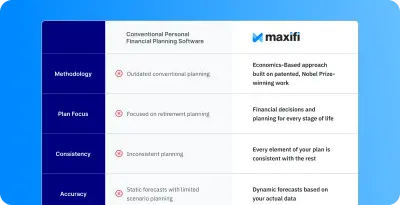
- Why MaxiFiMaxiFiEconomics-Based PlanningHow MaxiFi's economics approach gives you a clear view of your financesCase StudiesReal stories about how MaxiFi helps users make smarter decisionsTestimonialsMaxiFi is trusted by households and experts for clarity and confidenceHow MaxiFi ComparesWith so many tools out there, how do you know MaxiFi is right for you?Press and ReviewsRead expert commentary and critical acclaim for MaxiFi
- Pricing
- AboutCompanyOur VisionThe best person to take control of your financial future is youMedia ResourcesLogos, background information, and media contactsFounder and AdvisorsMeet Laurence Kotlikoff and the visionary MaxiFi teamAffiliate ProgramShare MaxiFi with your audience to help them take control of their financesCareersWhy working at MaxiFi is rewarding, empowering, and impactfulContactQuestions or feedback? Get in touch with the MaxiFi team

Social Security for High Earners: IRMAA Surcharges and Benefit Reduction Strategies
For high earners, Social Security often looks simple on the surface. You paid in for decades, you qualify for benefits, and the formula appears fixed. Yet for affluent households, the real impact of Social Security is rarely about the benefit formula alone. It is about how benefits interact with taxes, Medicare premiums, and other income sources over time. That is where outcomes begin to diverge.
Interest in social security high earners has grown as more retirees discover that higher income can quietly change the net value of their benefits. Earnings above the taxable cap stop increasing benefits, but they can still shape payroll taxes. Social Security benefits may be taxed more heavily as income rises. Medicare premiums can increase through IRMAA surcharges based on prior-year income, even when monthly Social Security checks remain unchanged. None of these effects are obvious when benefits are viewed in isolation.
This topic matters because high earner households often experience Social Security as a coordination problem rather than a claiming decision. The same benefit amount can produce very different after-tax and after-premium outcomes depending on income timing, investment activity, and Medicare enrollment years. A one-year income spike, a Roth conversion, or a large capital gain can ripple forward into higher Medicare costs later, altering lifetime cash flow without changing the benefit itself.
This guide explains how Social Security works for high earners, focusing on the maximum benefit, earnings above the cap, taxation of benefits, and IRMAA surcharges. It also explores why simplified rules and single-variable calculators can miss important interactions, and why understanding tradeoffs across taxes, Medicare, and income timing is more informative than focusing on any single threshold.

Key Takeaways
- Social Security benefit formulas are the same for everyone, but high earners often face additional tax and Medicare premium effects that reduce net income.
- The maximum Social Security benefit is determined by lifetime earnings up to the taxable wage base and by claiming age, not by income above the cap.
- Earnings above the Social Security taxable maximum do not increase benefits, but they can still affect payroll taxes and future planning decisions.
- For married households, the family maximum applies to certain auxiliary benefits and is not a combined cap on two workers’ retirement benefits.
- Social Security benefits may be subject to federal income tax once combined income exceeds statutory thresholds, which high earners are more likely to cross.
- Taxation of benefits often depends on how Social Security overlaps with wages, required distributions, or investment income in retirement.
- IRMAA surcharges increase Medicare Part B and Part D premiums based on modified adjusted gross income from prior years.
- A single high-income year can trigger higher Medicare premiums later due to the two-year IRMAA lookback.
- In 2026, the Social Security taxable wage base is $184,500, which caps earnings counted toward benefits.
- Medicare Part B and Part D premiums rise in tiers under IRMAA, increasing total healthcare costs for higher-income retirees.
- Approaches to manage IRMAA exposure often involve income timing tradeoffs rather than eliminating surcharges entirely.
- Understanding how Social Security, taxes, Medicare premiums, and portfolio withdrawals interact is more useful for high earners than focusing on a single rule or cutoff.
Why Social Security high earners face different tradeoffs
Social Security rules do not change because someone earns a high income. The benefit formula, eligibility ages, and credit system apply equally across income levels. What changes for higher earners is the environment surrounding those benefits. Taxes, Medicare premiums, and overlapping income sources tend to play a much larger role in shaping net outcomes.
For affluent households, Social Security is rarely evaluated as a standalone income stream. Benefits often arrive alongside wages, investment income, required distributions, or business earnings. These overlaps can trigger taxation of benefits and higher Medicare premiums even when the Social Security benefit itself is unchanged. As a result, the question is often not how much Social Security pays, but how much of that benefit is retained after other systems interact with it.
This is why high earners often experience Social Security less as a claiming decision and more as a coordination challenge. Small differences in income timing or retirement sequencing can lead to meaningful differences in after-tax income and healthcare costs over time.
The maximum Social Security benefit and what determines it
The concept of a maximum Social Security benefit is often misunderstood. It does not reflect wealth or total lifetime income. Instead, it reflects how much of a worker’s earnings were subject to Social Security taxes and how long benefits are delayed.
What the maximum Social Security benefit represents
The maximum benefit is achieved by earning at or above the Social Security taxable wage base for at least 35 years and claiming benefits at the latest eligible age for delayed credits. Claiming earlier reduces the monthly amount, while delaying increases it. The maximum therefore reflects both sustained covered earnings and timing, not a special category for high-income retirees.
Monthly benefit amounts differ depending on whether benefits are claimed at age 62, at full retirement age, or after earning delayed retirement credits. These differences matter more for lifetime income than small variations in earnings late in a career.
Why earnings above the taxable cap do not increase benefits
Social Security only counts earnings up to the annual taxable wage base when calculating benefits. Income earned above that cap does not generate additional credits or increase the benefit formula. For high earners, this creates a ceiling on how much Social Security can replace, regardless of continued income growth.
Benefits are calculated using the highest 35 years of indexed earnings below the cap. Years above the cap do not receive extra weight. This structure explains why very high lifetime earners may receive benefits that look modest relative to their peak income.
How married households and the family maximum fit in
The family maximum is another area where confusion is common. It applies to certain auxiliary benefits paid on one worker’s record, such as spousal or dependent benefits. It does not cap the combined retirement benefits of two working spouses.
For high-income married couples where both spouses worked and earned benefits independently, each spouse’s retirement benefit is calculated separately. The family maximum matters primarily when multiple people are receiving benefits based on one worker’s earnings record.
The payroll tax cap and high income Social Security taxation
High earners often notice Social Security most clearly through payroll taxes rather than benefits. The taxable wage base determines how much income is subject to Social Security tax in any given year.
Earnings above the cap and the Social Security taxable maximum
In 2026, earnings above $184,500 are not subject to the Social Security portion of payroll taxes. Income beyond that level does not increase future benefits, but it can still influence overall tax exposure and retirement planning decisions.
For employees, this cap limits withholding. For self-employed individuals, it limits the Social Security portion of self-employment tax. In both cases, the cap reflects financing rules rather than benefit generosity.
Why the payroll tax cap is not benefit means testing
The taxable maximum is sometimes described as a form of means testing, but that framing is misleading. It does not reduce benefits based on wealth or income. It simply limits which earnings are counted in the system.
Means testing proposals involve altering benefits or eligibility based on income or assets. The payroll tax cap, by contrast, defines how the program is funded, not who receives benefits.
Taxation of Social Security benefits for high earners
Taxation often has a larger effect on high earners’ Social Security outcomes than benefit formulas do.
How provisional income determines benefit taxation
Social Security benefits may be subject to federal income tax once combined income crosses certain thresholds. Combined income includes adjusted gross income, tax-exempt interest, and a portion of Social Security benefits themselves.
High earners are more likely to exceed these thresholds because Social Security often overlaps with other income sources. This can result in a portion of benefits being included in taxable income, reducing the net value of monthly payments.
Income timing and overlap effects in retirement
The timing of income matters. Social Security benefits received during years with wages, large capital gains, or required distributions may face higher taxation than benefits received in lower-income years.
Two households with identical benefit amounts can experience very different tax outcomes depending on when benefits are claimed and how other income sources are sequenced.
IRMAA surcharges and Medicare premiums
IRMAA introduces another layer of complexity for high earners by increasing Medicare premiums based on income.
What IRMAA changes and what it does not
IRMAA affects Medicare Part B and Part D premiums. It does not reduce Social Security benefits directly. However, higher premiums reduce net retirement income, which is why IRMAA often feels like a benefit reduction in practice.
Premium increases are tiered, meaning that higher income can move a household into progressively higher premium brackets.
The two-year lookback and one-time income events
Medicare uses income from prior years to determine current premiums. As a result, a one-time income spike can trigger higher premiums later, even if income subsequently falls.
Events such as business sales, large Roth conversions, or unusually high investment income can affect Medicare costs years after they occur.
IRMAA tiers and premium exposure at a high level
IRMAA premiums rise in steps rather than gradually. Crossing a threshold can increase monthly premiums for an entire year. These effects are magnified for couples, as both spouses may face higher premiums.
Income coordination approaches high earners evaluate
High earners often focus less on avoiding surcharges entirely and more on managing tradeoffs over time.
Why managing timing matters more than hitting a threshold
Focusing narrowly on staying below a single income cutoff can distort broader planning decisions. Income that reduces taxes or improves long-term flexibility may still raise short-term premiums.
Evaluating tradeoffs across multiple years often provides more insight than attempting to optimize around one threshold.
Roth conversions and IRMAA interactions
Roth conversions can increase taxable income in the year they occur, potentially triggering IRMAA surcharges later. At the same time, they may reduce future required distributions and taxes.
Understanding these interactions helps frame conversions as tradeoffs rather than clearly good or bad decisions.
Capital gains realization and taxable account coordination
The timing of capital gains affects both income taxes and Medicare premiums. Gains realized in a single year can increase exposure to IRMAA even if long-term investment strategy remains unchanged.
Charitable strategies and qualified charitable distributions when relevant
Some households use charitable giving to reduce taxable income. When applicable, these strategies can affect both income taxes and Medicare premiums, though their usefulness depends on account structure and eligibility.
A coordination view of Social Security for wealthy retirees
For high earners, Social Security rarely operates in isolation. Benefits, taxes, Medicare premiums, and portfolio withdrawals interact across time.
Why single-variable calculators often mislead
Tools that focus only on benefit amounts or claiming ages often ignore taxation and Medicare costs. This can overstate the real value of Social Security for affluent households.
How modeling can clarify tradeoffs without prescribing outcomes
In more complex situations, some households use comprehensive financial planning software such as MaxiFi to model how income timing, taxes, Social Security, and Medicare premiums interact over time. The value lies in illustrating sensitivity and tradeoffs rather than identifying a single correct answer.
Means testing Social Security and policy uncertainty
Concerns about future means testing often surface among high earners, but the term is used inconsistently.
What means testing usually refers to in policy debates
Means testing can describe proposals that reduce benefits, change formulas, or increase taxation for higher-income households. These ideas differ significantly in structure and impact.
Why timing and cohort exposure matter more than headlines
Most proposals involve gradual phase-ins and apply to future cohorts rather than current retirees. As a result, individual exposure depends heavily on age, timing, and how changes are implemented.
Understanding mechanics and uncertainty is more informative than reacting to predictions or headlines.
Financial Planning that Puts You in Control
Frequently Asked Questions About Social Security for High Earners
Important Considerations
The information discussed here reflects current Social Security and Medicare rules as they are understood for 2026, where income thresholds, benefit formulas, and premium structures are relevant to high earners. Examples and scenarios referenced throughout the article are illustrative and intended to explain how different rules interact, not to suggest specific actions. Outcomes related to Social Security benefits, taxation, and Medicare premiums can vary widely depending on individual circumstances, including health and longevity expectations, the mix and timing of income sources, tax law changes, and personal spending patterns. For higher-income households in particular, small differences in timing or income overlap can lead to materially different results over time.
Long-term retirement decisions involve tradeoffs and uncertainty rather than single right answers. Simplified rules, assumptions, or single-variable tools may overlook important interactions between Social Security, taxes, Medicare premiums, and portfolio withdrawals. In more complex situations, comprehensive financial planning software such as MaxiFi can be used to illustrate how these elements coordinate across time, helping clarify tradeoffs without prescribing outcomes or reducing decisions to rules of thumb.
Disclaimer
This article provides general educational information only and does not constitute legal, tax, or estate planning advice. Beneficiary designations, estate laws, and tax regulations vary significantly by state, account type, and individual circumstances. The information presented here is not intended to be a substitute for personalized legal or financial advice from qualified professionals such as estate planning attorneys, tax advisors, or financial planners. Beneficiary rules are subject to change and can have significant legal and tax implications. Before designating, changing, or making decisions about beneficiaries, you should consult with appropriate professionals who can evaluate your specific situation and applicable state and federal laws.