- FeaturesFeaturesHow it WorksUnderstand the MaxiFi features that help you build your lifetime planRoth Conversion OptimizerMaxiFi helps you optimize conversions and reduce taxesUse CasesHow can you put MaxiFi to use?Life Insurance Contingency PlanningGet peace of mind from life insurance recommendations tailored for youLiving Standard Monte CarloManage your living standard risk with confidence

- ServicesServicesOverviewChoose the right level of support for your plan and needsFlight CheckGet off the ground with comprehensive guidanceCo-PilotElevate your financial plan with one of MaxiFi’s certified financial plannersConcierge ServicePersonal, expert support to make the most of your financial plan
 Flight Check ServiceAsk your questions and make sure your plan is ready for take off with a MaxiFi expertLearn More
 - ResourcesResourcesWebinars and PodcastsExpert tips and guides to help you get the maximum from MaxiFiArticlesIn-depth commentary on the financial planning landscapeBooksFrom the world-renowned economist behind MaxiFiBlogInsights to help you optimize your financesFAQYour most pressing questions answeredFinancial GlossaryKey financial concepts explained in detail

- Why MaxiFiMaxiFiEconomics-Based PlanningHow MaxiFi's economics approach gives you a clear view of your financesCase StudiesReal stories about how MaxiFi helps users make smarter decisionsTestimonialsMaxiFi is trusted by households and experts for clarity and confidenceHow MaxiFi ComparesWith so many tools out there, how do you know MaxiFi is right for you?Press and ReviewsRead expert commentary and critical acclaim for MaxiFi
- Pricing
- AboutCompanyOur VisionThe best person to take control of your financial future is youMedia ResourcesLogos, background information, and media contactsFounder and AdvisorsMeet Laurence Kotlikoff and the visionary MaxiFi teamAffiliate ProgramShare MaxiFi with your audience to help them take control of their financesCareersWhy working at MaxiFi is rewarding, empowering, and impactfulContactQuestions or feedback? Get in touch with the MaxiFi team

Why Economics Based Planning Beats Retirement Rules of Thumb
Many retirement planning conversations rely on familiar rules of thumb. Ideas about saving targets, withdrawal percentages, or ideal retirement timing are widely shared because they offer clarity in an otherwise complex process. Yet real world outcomes often diverge sharply, even among households that appear to follow the same rules. This gap between expectation and reality has led more people to question whether simplified rules are enough to explain how retirement actually works.
This topic matters because retirement is not a single decision or a static calculation. It unfolds over time and is shaped by interacting factors such as taxes, Social Security, income timing, spending needs, health, and longevity. Rules of thumb were created to simplify these moving parts, but simplification often comes at a cost. When a rule focuses on one variable in isolation, it can overlook how decisions in one area affect outcomes elsewhere. That limitation helps explain why similar inputs can still lead to very different results.
What does "rules of thumb" mean in this context? The term refers to the simple formulas and shortcuts that stand in for a detailed, personalised calculation. Examples include income replacement targets (such as replacing 80% of pre-retirement earnings), fixed withdrawal rates (such as the 4% rule), and savings multiples tied to age or salary. It also extends to picking a desired spending level and then estimating the probability of not running out of money, without testing whether that level is affordable.
Economics based planning approaches retirement from a system level perspective. Rather than centering on preset targets or standalone benchmarks, it examines how financial decisions influence living standards across an entire lifetime. This framework draws on economic principles such as consumption smoothing, which focuses on maintaining a stable living standard over time rather than overspending in some years and underspending in others. By focusing on coordination across income, taxes, savings, and spending, economics based planning highlights interactions that rules of thumb often miss.
This guide explores why rules of thumb became popular, where their limitations tend to appear, and how economics-based planning offers a more reliable framework for understanding long-term retirement outcomes. The economics behind this approach is not new, and many of these ideas and arguments go back over 70 years. The life-cycle model of household spending was formulated by economists Franco Modigliani and Richard Brumberg in 1954, building on earlier work by Irving Fisher, and developed over the following decades by researchers including Yaari, Samuelson and Merton. The goal here is not to replace one rule with another, but to help readers understand retirement planning as an interconnected process built on decades of peer-reviewed research, not simple formulas.

Key Takeaways
- Rules of thumb in retirement planning are simplified formulas and benchmarks, such as income replacement targets, fixed withdrawal rates, and savings multiples, that substitute for a detailed, personalised calculation.
- Retirement rules of thumb are widely used because they simplify complex decisions, but simplification can hide important interactions that shape long term outcomes.
- Following the same rule does not guarantee similar results, since household finances differ in income timing, taxes, health, and longevity.
- Economics based planning treats retirement as an interconnected system rather than a checklist of targets or formulas.
- A retirement planning approach grounded in economics focuses on how decisions affect living standards over an entire lifetime, not just account balances.
- Consumption smoothing is a core concept that explains why stable, sustainable spending often matters more than hitting a single savings goal.
- Living standard planning shifts attention away from net worth targets toward whether spending can be maintained across different stages of life.
- Rules of thumb problems often arise because they evaluate decisions in isolation instead of accounting for coordination across income, taxes, and benefits.
- Personalized planning recognizes that retirement outcomes vary widely even when starting conditions appear similar.
- Comprehensive retirement planning requires understanding tradeoffs rather than assuming there is one correct answer or universal rule.
- Economics based retirement frameworks emphasize uncertainty and adaptability instead of fixed conclusions.
- System level thinking helps explain why small changes in timing or assumptions can lead to large differences in outcomes.
Why Retirement Rules of Thumb Exist
Retirement rules of thumb developed as practical shortcuts in response to a complicated planning environment. For decades, individuals and planners needed simple ways to translate abstract financial goals into concrete actions. Guidelines about saving rates, withdrawal percentages, or target balances offered an accessible starting point for people who did not have the time, data, or tools to model retirement in detail. These rules reduced cognitive overload and made planning feel manageable.
Their appeal lies in simplicity. A single number or formula is easier to remember and communicate than a system of interacting variables. For planners, rules of thumb provided a consistent framework that could be applied across many households. For individuals, they offered reassurance and a sense of control in an otherwise uncertain process. This simplicity helped normalize retirement saving and encouraged participation, especially when financial literacy was limited.
At the same time, these rules were never designed to be decision engines. They were meant to approximate broad patterns under average conditions, not to account for the full range of personal circumstances or changing economic realities. Most rules assume stable relationships between inputs and outcomes, even though retirement planning is inherently dynamic. Understanding why rules of thumb exist helps clarify both their usefulness and their limitations.
The Structural Problems With Rules of Thumb
Rules of thumb tend to break down not because they are wrong in concept, but because they ignore important interactions that shape outcomes over time. Retirement decisions rarely operate in isolation. Choices about saving, claiming benefits, or spending affect each other in ways that simple rules cannot capture.
Interaction Effects Rules Ignore
Taxes, Social Security, income timing, and spending patterns interact continuously throughout retirement. A change in one area can alter results elsewhere. For example, when withdrawals increase taxable income, they may affect benefit taxation or future cash flow. Timing decisions can shift tax exposure across years, altering the sustainability of spending. Isolated rules evaluate each decision separately, which obscures how coordination matters.
Because these interactions compound over time, small differences can cascade into large outcome gaps. Two households following the same withdrawal rule may experience very different results if their income sources or tax profiles differ. Rules explain mechanics in isolation, but they do not explain how the system behaves as a whole.
Individual Variation and Uncertainty
Rules of thumb also rely on averages that rarely apply cleanly to real people. Longevity varies widely, health costs are uneven, and earnings paths differ across careers and households. Some risks are concentrated rather than evenly distributed. Market volatility, policy changes, and personal circumstances introduce uncertainty that static rules cannot adapt to.
As a result, rules may feel safe because they are familiar, but they often fail to explain why outcomes diverge. They describe what might work on average, not what happens under varying conditions. This gap is where many planning surprises occur.
What Economics-Based Planning Actually Means
Economics-based planning approaches retirement as a constrained system rather than a checklist of targets. Instead of asking whether a single benchmark has been met, it examines how decisions interact across time under uncertainty. This framework draws from economic principles that focus on tradeoffs, resource allocation, and lifetime outcomes.
At its core, economics-based planning treats retirement as a lifetime planning problem. Resources are finite, risks are unavoidable, and choices today affect options tomorrow. The goal is not to optimize a single variable, but to understand how combinations of decisions influence long term stability. This perspective naturally leads to personalized planning, since each household faces a unique mix of income sources, obligations, and risks.
By shifting attention away from isolated rules and toward system behavior, economics-based planning provides a clearer explanation of why similar strategies can lead to different results. It emphasizes coordination and adaptability rather than fixed conclusions.
Consumption Smoothing as the Core Economic Insight
One of the central ideas in economics-based planning is consumption smoothing. This concept explains how households seek to maintain relatively stable living standards over time, even as income fluctuates. Rather than focusing on peak balances or single year outcomes, consumption smoothing evaluates whether spending can be sustained across different life stages.
What Consumption Smoothing Explains
Consumption smoothing highlights the difference between volatile spending and stable living standards. Asset balances alone do not determine retirement success if spending swings sharply from year to year. A household may appear well funded based on net worth, yet still face periods of financial strain if income and expenses are poorly coordinated.
This concept also clarifies tradeoffs across time. Spending more today can reduce flexibility later, while underspending may lower quality of life unnecessarily. Economics-based planning evaluates these tradeoffs explicitly instead of assuming a fixed rule will balance them automatically.
Why Consumption Matters More Than Net Worth
Net worth does not translate directly into usable spending. Taxes, timing, and account structure affect how much of a balance can actually support living expenses. A large portfolio does not guarantee stable consumption if withdrawals trigger tax inefficiencies or collide with benefit rules.
Living standard planning reframes success by asking whether spending can be maintained sustainably rather than whether a target balance has been reached. This shift helps explain why focusing on consumption often provides clearer insight than focusing on asset totals alone.
Living Standard Planning vs Target-Based Planning
Target-based planning centers on hitting predefined numbers, such as a savings multiple or withdrawal rate. While these targets are easy to track, they struggle to evaluate sustainability across changing conditions. They assume that once a target is reached, outcomes will follow predictably.
Living standard planning takes a different approach. It evaluates whether a household can support desired spending across time while accounting for uncertainty and interaction effects. Instead of declaring success at a single point, it continuously assesses how decisions affect future flexibility.
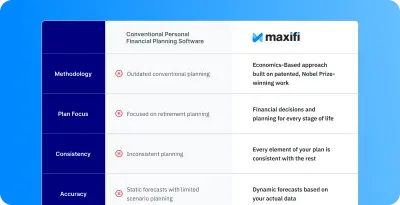
This approach reinforces adaptability. It recognizes that plans must respond to new information, policy changes, and personal circumstances. Software such as MaxiFi illustrates this framework by modeling lifetime living standards across interacting variables rather than relying on fixed retirement targets.
Why Comprehensive Retirement Planning Requires System-Level Modeling
As retirement decisions grow more interconnected, comprehensive planning requires tools and frameworks that reflect system behavior. Evaluating decisions one at a time misses how timing and coordination shape outcomes.
Coordinating Social Security, Taxes, and Spending
Social Security, taxes, and spending decisions influence each other throughout retirement. Claiming choices affect taxable income, which in turn affects spending capacity and benefit taxation. Sequencing withdrawals across account types can alter cash flow stability and long term sustainability. Understanding these relationships requires looking beyond mechanics to interactions.
Why Oversimplified Tools Break Down
Simple calculators and static projections often assume fixed relationships that do not hold over time. They may ignore tax changes, benefit coordination, or shifting spending needs. As a result, they can produce projections that look precise but fail to capture real world complexity.
A comprehensive retirement planning approach integrates these moving parts into a unified model. By emphasizing system-level interactions and personalized assumptions, economics-based planning provides a more accurate framework for understanding retirement outcomes than rules of thumb alone.
Financial Planning that Puts You in Control
Frequently Asked Questions About Economics-Based Retirement Planning
Important Considerations
The concepts discussed in this article reflect current understanding of economics-based retirement planning and relevant rules as of 2026, where applicable. The examples and frameworks described are intended to illustrate how retirement outcomes can be shaped by interactions across income, taxes, Social Security, savings, and spending, rather than to suggest any particular course of action. Retirement planning outcomes vary widely by individual circumstances, including health and longevity, the timing and composition of income sources, exposure to tax and policy changes, and personal spending patterns over time.
Long-term retirement decisions involve uncertainty and tradeoffs, not single right answers. Simplified rules of thumb, static targets, or standalone tools may overlook important interactions that affect living standards across a lifetime. Approaches that evaluate retirement as a coordinated system can help clarify these interactions. For example, comprehensive financial planning software such as MaxiFi can model how changes in income timing, taxes, and spending affect sustainable living standards, illustrating why system-level coordination often matters more than isolated assumptions.
Disclaimer
This article provides general educational information only and does not constitute legal, tax, or estate planning advice. Beneficiary designations, estate laws, and tax regulations vary significantly by state, account type, and individual circumstances. The information presented here is not intended to be a substitute for personalized legal or financial advice from qualified professionals such as estate planning attorneys, tax advisors, or financial planners. Beneficiary rules are subject to change and can have significant legal and tax implications. Before designating, changing, or making decisions about beneficiaries, you should consult with appropriate professionals who can evaluate your specific situation and applicable state and federal laws.